
Today, you can get low-quality knockoffs of just about any popular smartphone on sites like AliExpress or Temu, whether they be iPhones, Galaxy phones, or whatever else. They have terrible build quality, bottom-of-the-barrel components and specifications, and all run outdated versions of Android – badly. At the same time, various consumer electronics brands, once popular in a bygone era, sell the rights to their brand name to unknown companies, who then put these brands on generic hardware to give their products a sheen of legitimacy. That’s why today, you can still buy Nokia smartphones, Polaroid cameras, and low-effort Hi-Fi equipment from various once-respected brands.
None of this is new, however. In the late ’90s and early 2000s, companies were already doing the same thing. In fact, there’s one device from this era which combines both business practices – it’s both a cheap knockoff of a wildly successful device, and it carries a once-revered brand name. Also, just to add some juice, this story involves stolen source code.
Let’s take a look at the worst PDA of all time, the Olivetti daVinci.
The OSNews 2026 Fundraiser
➡️ Donate through Ko-Fi ➡️ Donate through SEPA transfer* ➡️ Buy merch from our store ➡️ Why a fundraiser?
€5000 incentive: Make me use Windows 11 for a month (the results were not great)
> €10000: Video tour of my office and my computers/devices collection <
€15000: Buy a Mac and use macOS for a month (and review it)
€20000: I get an OSNews tattoo
*Name: Thom Holwerda – IBAN: SE08 8000 0820 1684 4657 8414 – BIC: SWEDSESS
In 1997, Palm launched the Palm Pilot, and it and its successors proved to be a massive hit. Where countless before it had failed, Palm found the magic formula to make pocket computing work. I wrote an in-depth article about Palm over 13 years ago which goes into much (much) more detail, but the reason the Palm Pilot succeeded where things like the Newton, PenPoint OS, and Windows for Pen Computing failed, is that Palm’s founder, Jeff Hawkins, realised that they were competing with paper, not with desktop computers. Instead of trying to shove the capabilities of a full personal computer into a (barely) pockatable device, a pocket computer had to be as fast and convenient as paper, and therefore extremely strict about which features to add, and which to omit.
To this day, the entirety of smartphone computing stands on the shoulders of Palm. Palm’s ideas, implementations, approaches, paradigms, and even people were absorbed by Apple and Google, where they shaped both iOS and Android. The phone you’re looking at right now has a ton of Palm DNA in it, still. After all, you’re still using the homescreen-with-apps paradigm Palm already perfected in the late ’90s and early 2000s.
The success of the Palm Pilot and its successors did not go unnoticed. Microsoft, most prominently, felt incredibly threatened by Palm’s success:
The success of Palm’s products got the attention of Microsoft, and the company pretty much announced it was going to crush Palm. According to Hawkins, Microsoft had a sales conference, where, at some point, a big target appeared on the projector screen, with the Palm logo dead in the centre of it: “we are going to crush and kill these guys”, was the central message. Hawkins recalls that he got condolence letters after that, stating things like “Sorry Jeff. Too bad.”
↫ Thom Holwerda
While Microsoft proved to be unable to “kill and crush” Palm, it did manage to build a relatively successful business selling PDAs running various incarnations of Windows CE. Together, Palm and Microsoft dominated the PDA market pretty much throughout its entire existence, and while the market was a mere fraction of the smartphone market of today, other companies still wanted a piece of this pie too. One of these companies was Olivetti, a storied Italian company with a long history making typewriters, computers, and other electronics.
I’m not going into detail about Olivetti’s history, but the company was renowned for its attention to design, creating iconic products like the Lexikon 80, Lettera 22, Elea 9003, Programma 101, and so, so many more. Olivetti also entered the personal computer market, first with a variety of custom machines featuring Z80 and later Motorola 68000 processors running a variety of custom operating systems developed by Olivetti (including its own UNIX variant, X/OS). After a few machines using MIPS and Alpha processors in the early ’90s, the company would eventually focus entirely on Intel-based PCs (including this amazing failure) running Windows. Like so many other computer makers from that era, Olivetti eventually left the PC business by selling it off in 1997.
To this day, Olivetti PCs tend to cost more on the used market than those from other brands, despite no technical merits dictating so.
At around this time, our current story begins. Seeing the success of the Palm Pilot and the emergence of copycat devices running Microsoft’s Windows CE, Olivetti wanted in on the action. And so, in the late ’90s, the company introduced the Olivetti daVinci, a line of PDAs whose software looked suspiciously like Palm OS. There’s not a ton of information out there about the development history, but it seems that while Olivetti designed the hardware, it contracted the development of the operating system out to a company from Hong Kong, Echolink Design.
And this is where things went horribly wrong for Olivetti. The software Echolink Design developed for the daVinci didn’t just look like Palm OS, it was Palm OS – at least, according to Palm. After being on the market for about a year, the Palm Pilot maker, then a subsidiary of 3Com, filed for an injunction, alleging that the daVinci operating system designed by Echolink Design contained actual Palm OS source code. In addition, Palm also filed suit against CompanionLink Software, the company that developed the Outlook synchronisation software for the daVinci. Palm won handily, and within a day of the filing, temporary restraining orders were put in place on both Olivetti and CompanionLink, stopping sales of the daVinci and its software dead in its tracks.
It seemed to have been a pretty clear-cut case. From The Wall Street Journal at the time:
U.S. District Judge James Ware ruled Olivetti’s Royal daVinci organizer contains software that appears to have been copied from the operating system for 3Com’s Palm organizers. Judge Ware said a review by a software expert found the daVinci software contains private Palm code and even grammatical mistakes that appear to have been “copied verbatim.”
↫ Wall Street Journal Staff Reporter
It’s difficult to ascertain what code, exactly, was stolen, but my personal educated guess is that it probably involved Palm’s unique Graffiti handwriting recognition system. Graffiti actually predates the first Palm Pilot, and was available on a variety of non-Palm devices; it doesn’t seem entirely unlikely to me that the code for it escaped containment that way, eventually finding its way to Echolink Design. I’m just guessing here, though, as I can’t seem to find any of the original court documents concerning the case.
In a bind, Olivetti claimed the copied code represented less than 2% of the operating system’s code, and set about to release a new version of the software for the daVinci.
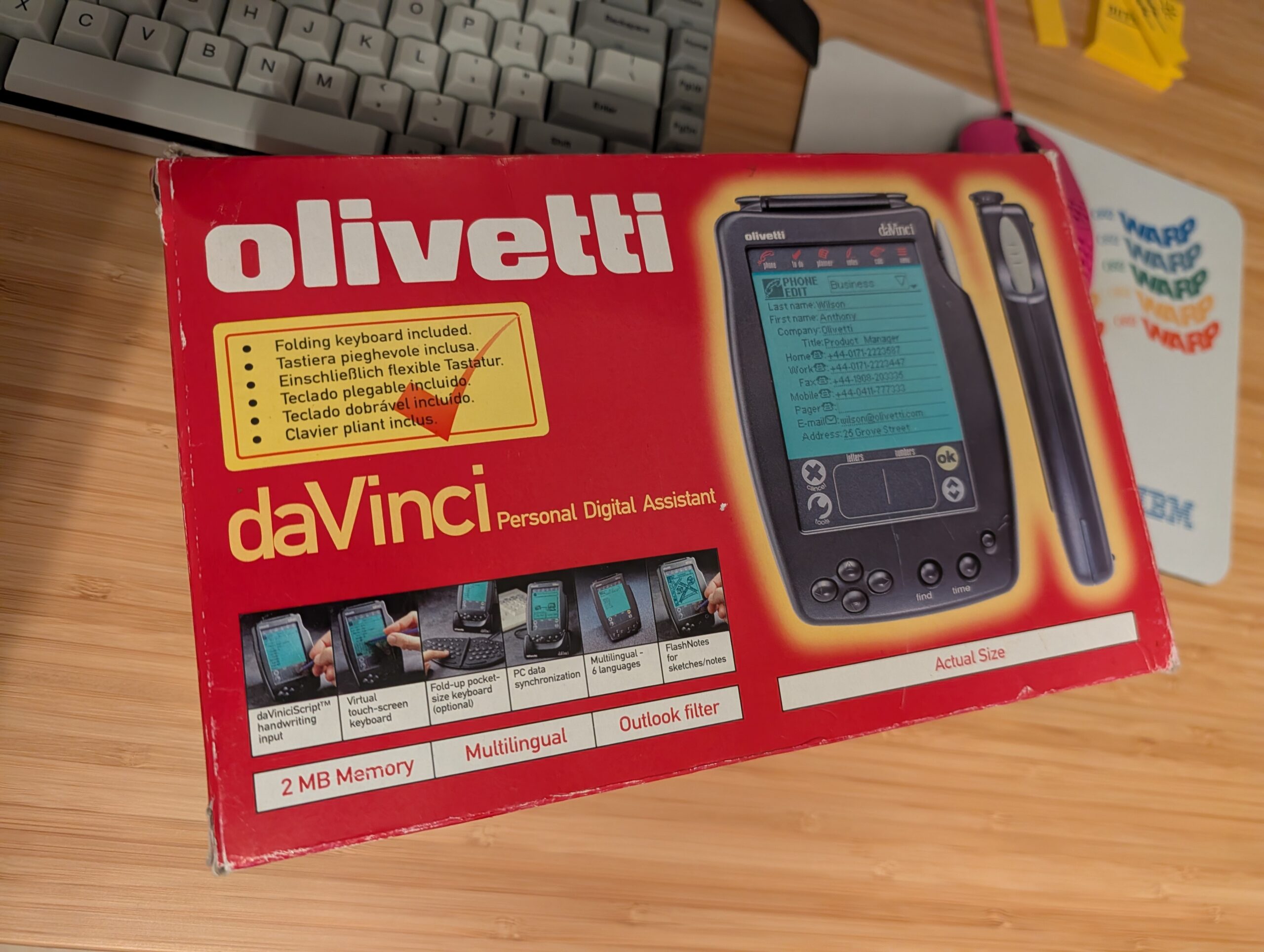
And so we end up at the device I have in my collection. Several years ago, I bought a boxed version of the Olivetti daVinci DV3, including all of its original accessories for a pittance on eBay, and I’ve been fascinated and repulsed by this device ever since. It looks like a cheap Palm knockoff, and it feels like one too; the hardware is made out a really unpleasant form of plastic, with buttons worse than what you find on the cheapest possible pack-in remote control. The case feels creaky and unrefined, like the cheapest possible children’s toy.
The display has a resolution of 128×99, much lower than the 160×160 of even the first Palm Pilot, and it’s incredibly dim and hard to read without the backlight on; even with the backlight on, it’s difficult to read anything. Worse yet, the various hardware tap targets on top of and at the bottom of the display are not backlit at all, making them unreadable in all but the most illuminated environments. Considering you need these buttons a lot, it’s a major stumbling block. Turning on the backlight is confusing, too, as it you need to hold down the on/off button (while the display is on) to engage it, something only mentioned in the manual.
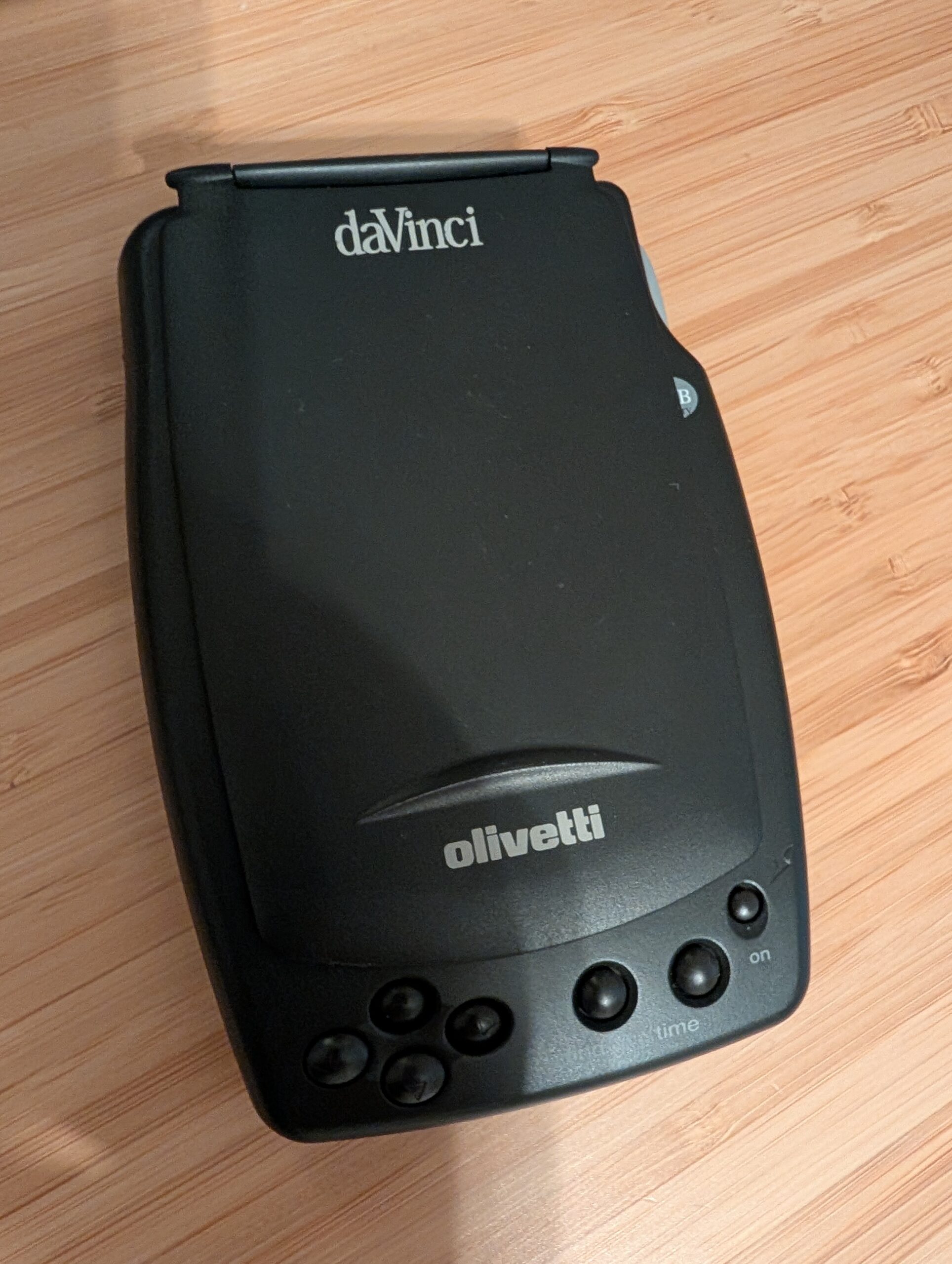
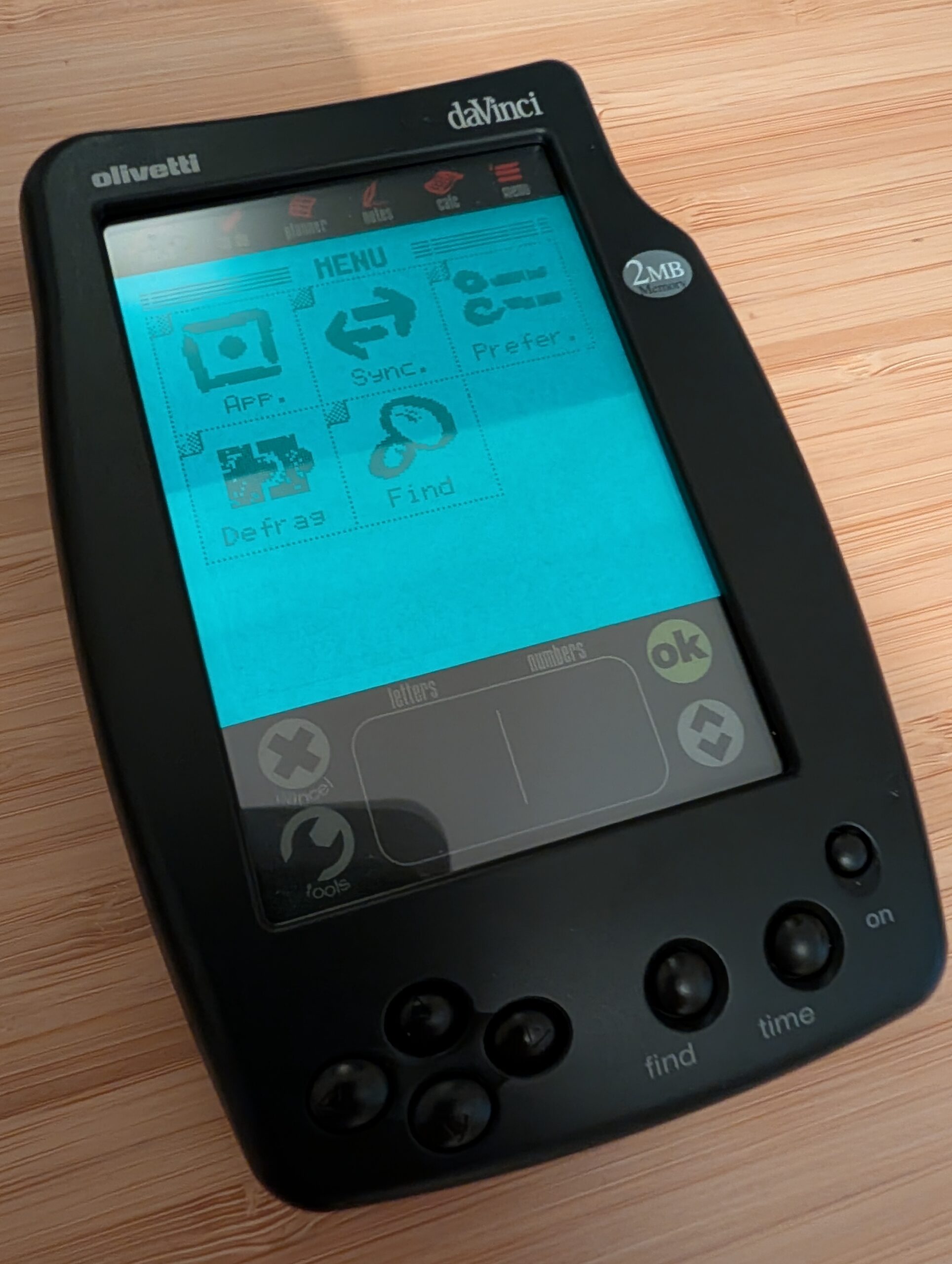
The display is, of course, a resistive touchscreen, as was the norm at the time, but its precision seems much lower than anything Palm ever offered. The accompanying stylus, too, is plasticky and cheap, definitely worse than the plastic styluses Palm shipped with its earlier models, and obviously no match for the metal styluses that would accompany later models.
Finding out exactly what type of processor the daVinci DV3 uses is remarkably hard. A contemporary review by Smart Computing claims it’s using an unspecified Epson processor, without giving any further details. There’s only one source that specifically states what processor it has, and considering that source is the only person to have written a third-party application for the DV3, I’m inclined to believe they’re right (opening the device up is of no use, as the SoC is of the epoxy blob type). According to them, the DV3 runs on a Sharp SM6010 microprocessor, for which a datasheet and more detailed documentation exists. The SM6010 is a very basic 16bit single-chip microcomputer of an unspecified architecture (probably something custom and proprietary), running at 30Mhz.
The SM6010 is a 16-bit single-chip microcomputer incorporating a 16-bit CPU core, LCD controller, watchdog timer, serial interface (UART, SCI), SIR, PWM output, real time clock, A/D converter and bus controller.
↫ Sharp SM6010 datasheet
The DV3 stores its operating system in flash memory – making it upgradable – and has 2MB of RAM, stated proudly all over the box and on a sticker on the device itself. Performance is actually not that bad, but it’s not quite as instant and responsive as Palm OS. The operating system and its user interface are rather inscrutable; there doesn’t seem to be a single home screen you can always go back to like on Palm OS, and closing/leaving applications/screens is done differently for each individual application/screen (tap the hardware “OK” button? An on-screen “OK” button? Press the cancel button? Tap one of the hardware application shortcuts atop the display? Who knows!).
The core tools of the DV3 are incredibly basic, and cover merely the bare necessities of a PDA in the late ’90s, with things like an address book, notes application, calendar, calculator, and a few others. There’s no consistency among any of these tools, and they all look, feel, and work just differently enough to be confusing. The daVinci is also Very Serious™, as there’s no games or even a simple drawing gimmick; in fact, while there is a button labeled “Apps.”, it doesn’t actually do anything (we’ll get back to that). There’s barely any preferences to fiddle with either.
Input is done via a terrible Graffiti ripoff called daVinci Script, which uses strokes much more cumbersome than its inspirator, not aided by the absolutely trash recognition algorithms. This input method is effectively unusable, as it’s impossible to predict which strokes will produce what character or action. Even something as simple as the right-to-left stroke to delete a character is entirely unreliable, ensuring this is more of a random character generator than a text input system. Luckily, there’s a tiny on-screen keyboard you can use to hunt and peck with the stylus, but this isn’t exactly a particularly fast input method either.
It’s hard to convey just how utterly terrible the software experience is, especially in 2026 when many people reading this lack the frame of reference of its time. This isn’t utter trash compared to what we’re used to today – this is utter trash compared to the competing devices running Palm OS and Windows Pocket PC of its time. Even in 2026, I love using Palm OS and Pocket PC, but I absolutely despise, dread, and hate using the daVinci. I’m struggling to find a comparison with something contemporary, but the best I can come up with is like comparing an Apple Watch or WearOS device with one of those cheap knock-off smartwatches that run some shitty custom low-res UI on an underpowered SoC, but honestly, even that does a disservice to these knock-off smartwatches.
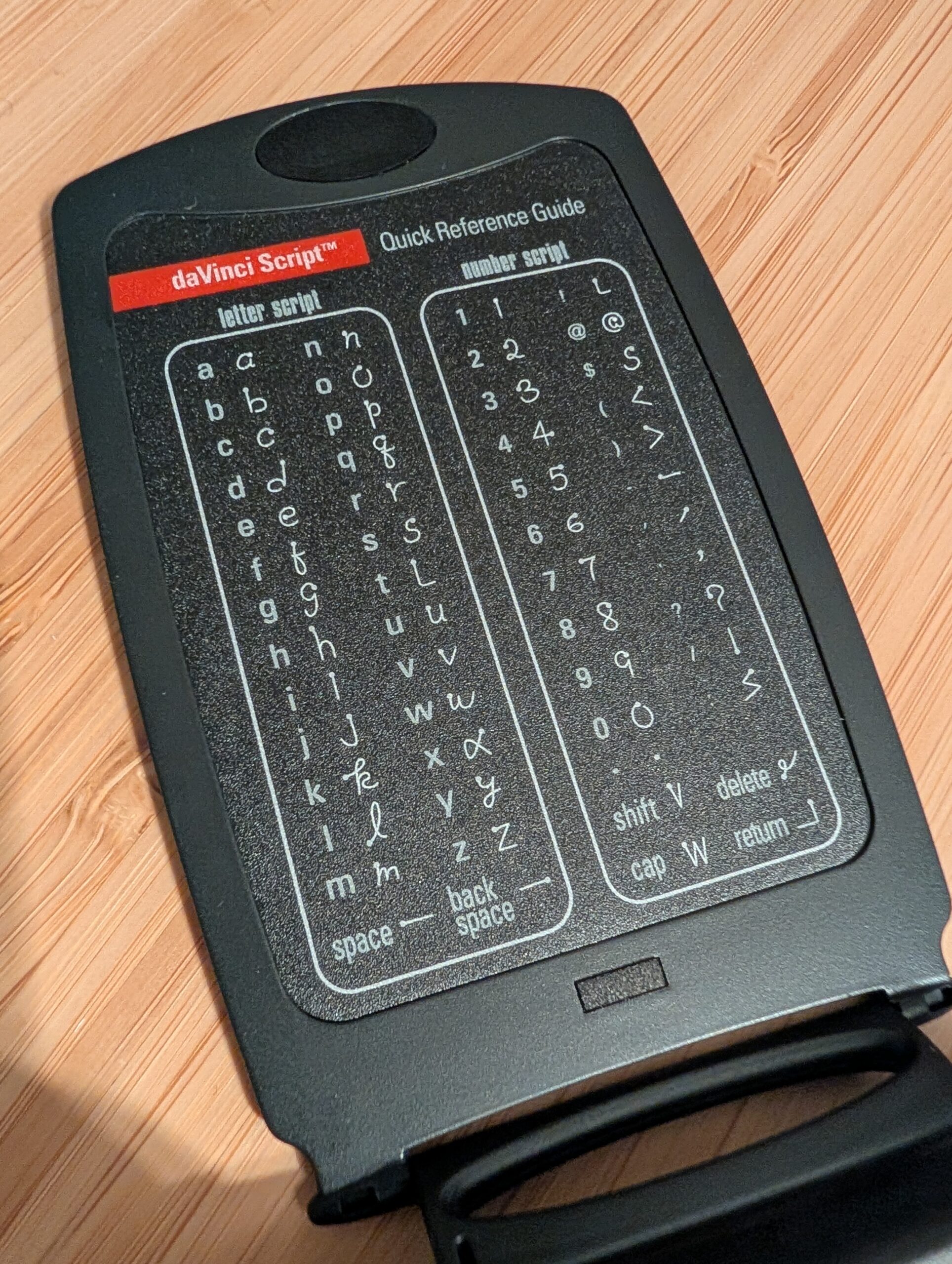
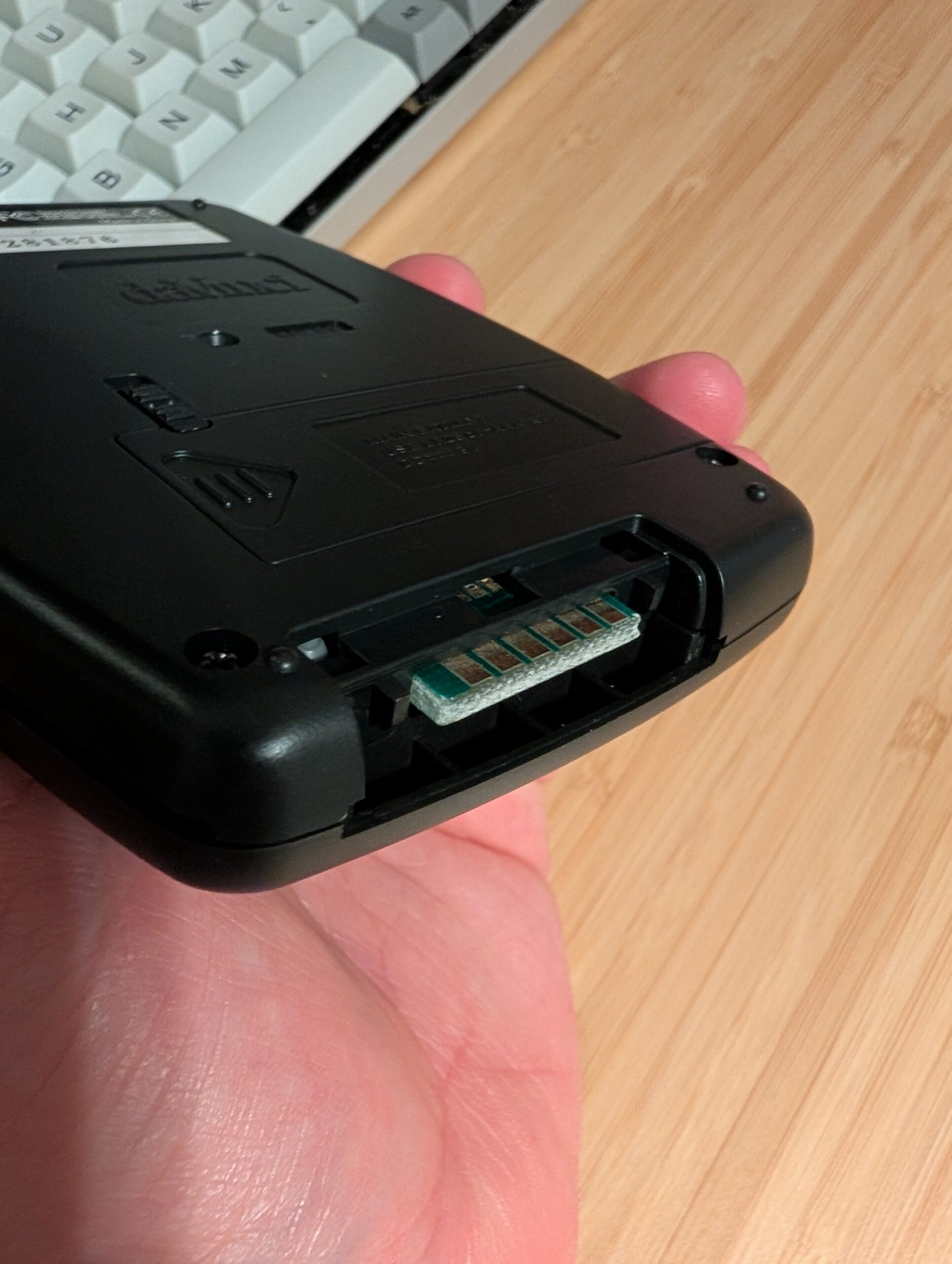
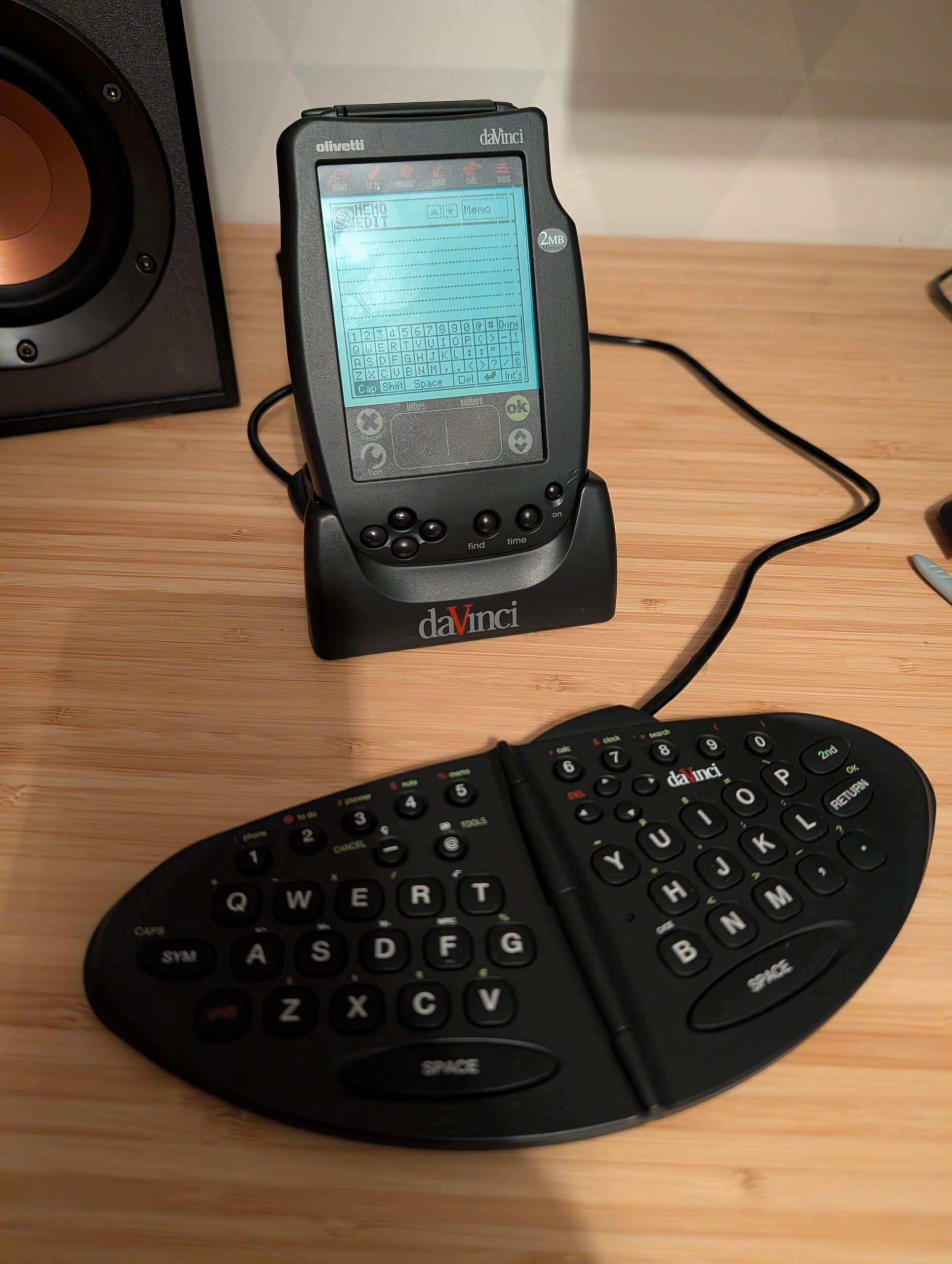
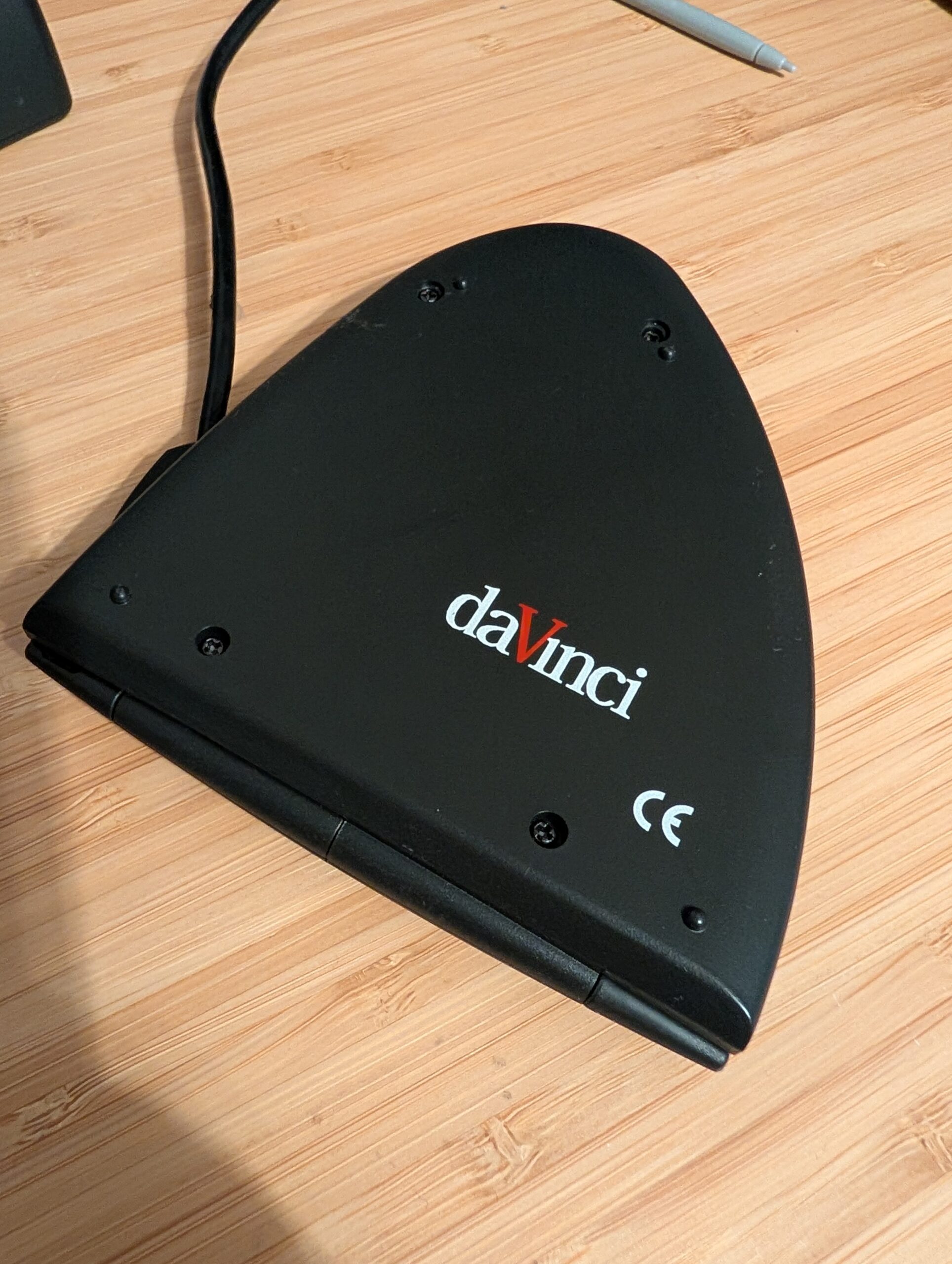
The daVinci I have came with all of its original accessories. There’s a vinyl pouch, a dock, and an external, fold-up keyboard. The pouch has not withstood the test of time, and has shrunk, so much so the daVinci no longer fits inside of it. The dock is, well, a dock, and uses the connector at the bottom of the daVinci. This connector looks and feels exactly like a crunchy ISA slot from the ’80s, as if the PCB was cut off with a hacksaw. The keyboard is the most interesting, and can be connected straight to the device’s bottom connector, or to a passthrough port at the back of the dock. Unsurprisingly, this keyboard is really bad, with dome-shaped mushy rubber keys with very little stability and a featherlight base that moves at the slightest of touches, making it almost impossible to type on.
Thanks, I hate it.
I mentioned the mysterious, non-functional “Apps.” button earlier, and there’s actually a bit of history here. It turns out that Olivetti fully intended for people to write third-party applications for this thing, promising to release an SDK at some point in time. Of course, this never ended up happening as the daVinci is trash and nobody in their right mind bought one or would want to develop for it, but it does mean that somewhere out there, perhaps in an attic somewhere in Ivrea, Italy, there’s a dusty hard drive or CD-ROM carrying this unreleased official SDK.
SDK or no, there’s always someone crazy, skilled, and determined enough to develop something for any computer, and for the daVinci DV3, that person was Alex Zwiesele. Zwiesele figured out that while the official SDK was never released, the CD-ROM that came with the daVinci DV3 contained the entire operating system of the DV3 and a loader program. This was enough for Zwiesele and a few other people to start disassembling the operating system and inject their own custom code into the binary file, reassemble it, and load it onto the DV3 using the loader program.
This was not a walk in the park. Zwiesele documented the entire process on their website, and it involved Zwiesele and several others writing their own disassembler and assembler (still available from their website!) based on the available Sharp SM6010 documentation, as well as learning how to actually program for the device’s hardware. In the end, they managed to develop an actual game for the daVinci DV3, a Breakout clone. You load the game onto your DV3 in the same way you’d load the operating system; as such, the game will replace the entire operating system and load automatically on power-on. That’s as far as they got back in 2003, as efforts seem to have stalled after that.
Back when I bought my daVinci, about 6-7 years ago, I mentioned online that I had bought the worst PDA of all time, without mentioning it by name. Immediately, fellow hardcore PDA enthusiasts (we exist) knew I was talking about the daVinci. This thing is just plain trash, e-waste before the term had been popularised, a waste of everyone’s time, effort, and money. Not even its one redeeming quality – its low price of just $99 compared to the cheapest Palm device at $249 – could make anyone want to use it.
Still, I’m glad I have it in my collection, if only to serve as a reminder that shitty e-waste devices aren’t something exclusive to our current smartphone era. It also serves to underline just how great Palm OS and Windows Pocket PC (yes, I will fight you on this) really were, and how many things they each got right out of the gate. So much so that especially Palm OS laid the foundations for every smartphone we use today.
Now that I’ve finally written and published this article, I can put this abomination back in its box, and never take it out again.

Now that I’ve read this article, I want to pull my Palm m125 out of its box and give it some love and attention.
Yes, truely the worst one. I have two in my collection. Really bad.
I have a minor complaint: This isn’t a case of a formerly a great brand that has become a trademark licensing organization and has no input on the design other than emailing a trademark and a logo to a white-label manufacturer (like “Grundig” stereos and “Toshiba” TVs are today), this is a case of Olivetti’s management knowing what very well they were doing (cutting every corner to meet that magical $99 price).
A more apt comparison is those “Voodoo-killer” 3D accelerators that couldn’t run even the least demanding Direct3D games and cut all kinds of corners that shouldn’t have been cut to meet that magic $99 price. And don’t say it didn’t happen:
https://www.youtube.com/watch?v=DegsPvN4JSI&lc=Ugz3YMyrsBHuyjCnlgN4AaABAg
https://www.youtube.com/watch?v=P_tEA3VCIBY&t=239s
* very well they were doing (sorry)