Thom Holwerda Archive

The Word Trojan: Anatomy of an Online Story

"Lately I've been blogging quite a bit on the state of on-line journalism. One aspect of that topic that I haven't touched on for awhile is the way in which a story breaks, builds, morphs and spreads electronically. The recent announcement of the Backdoor.Ginwui virus provides an interesting opportunity to do this once again, in order to see who addressed the story and how (including by me), and what, if anything, it all means." OSNews did not report on this Backdoor.Ginwui virus.

Apple vs. Does: Court Rules Internet Journalists Are Protected by Law

"In a decision that could set the tone for journalism in the digital age, a California appeals court ruled Friday that bloggers, like traditional reporters, have the right to keep their sources confidential. A panel of three judges said in a 69-page decision that a group of bloggers did not have to divulge their sources to Apple, contending that the same laws that protect traditional journalists, the First Amendment, and California's Shield Law, also apply to bloggers." My take: You already know how I feel about this, but I still need to say it, and I do not care if I get flamed for saying it: this is a clear-cut victory for the freedom of speech and press in the US (I live in The Netherlands, though), and you should all be happy Apple did not win this case. Update: Ars has an analysis and history of the case.

Address Space Layout Randomization in Windows Vista

"Windows Vista Beta 2 includes a new defense against buffer overrun exploits called address space layout randomization. Not only is it in Beta 2, it's on by default too. Now before I continue, I want to level set ASLR. It is not a panacea, it is not a replacement for insecure code, but when used in conjunction with other technologies, which I will explain shortly, it is a useful defense because it makes Windows systems look 'different' to malware, making automated attacks harder." On a related note, Microsoft is having difficulties in reaching parity between the 64bit and 32bit version of Vista concerning the amount of drivers shipped.

GNU-Darwin Gets Opteron Support

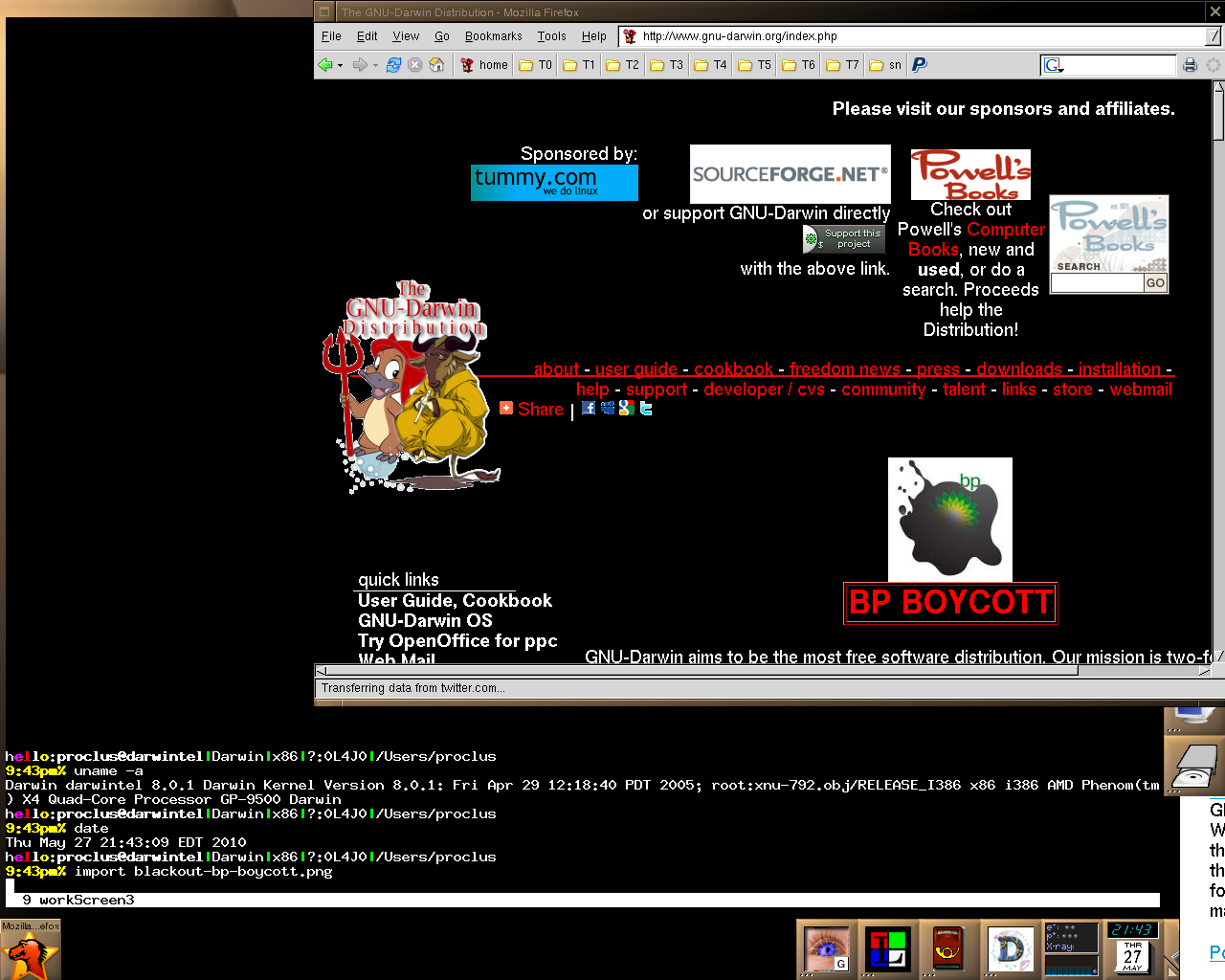
GNU-Darwin has gotten support for AMD's Opteron processors. "Mac OS X users are welcome to give free software a try now. I finally got a chance to try GNU-Darwin-1.1 on an Opteron machine with Darwin-7.2. Testing with glxgears confirms that the MesaGL is performing about twice as fast as on a comparable 32-bit CPU, although some other tasks are clearly not yet optimized. The machines are otherwise roughly identical. Here is a screenshot."

Remastering Damn Small Linux

This guide explains how to expand Damn Small Linux to fit your needs. "For those unfamiliar with the Distro, DSL is a severely stripped down version of Debian/Knoppix. The distribution aims to include as many useful applications as possible while remaining under 50MB. It uses a 2.4 series kernel, busybox, a tiny little Xserver, Fluxbox as the default WM, and a host of other microscopic office, media and Internet applications. It is designed to be easily expandable by via a system called 'MyDSL'."

DTrace for FreeBSD

Sun dtrace developer Bryan Cantrill reports on the progress being made by John Birrel on porting dtrace to FreeBSD. "While John has quite a bit further to go before one could call it a complete port, what he has now is indisputably useful. If you run FreeBSD in production, you're going to want John's port as it stands today - and if you develop for the FreeBSD kernel (drivers or otherwise), you're going to need it (once you've done kernel development with DTrace, there's no going back)."

Dell, Google Team Up

Dell and Google have struck a deal, Google's CEO confirmed on May 25. Speaking at an investor conference in Las Vegas, Google CEO Eric Schmidt acknowledged that Dell and Google have reached an agreement. Schmidt provided few details of the agreement that earlier speculation had placed in the $1 billion range. So far a co-branded Web site is the most visible aspect of the collaboration, but the cracks that occurred in the Microsoft/Dell/Intel troika when Dell allowed AMD to come to its party, have now reached the earthquake stage.

Sun Stuns Server Market in Q1 with Sales Spike

The server market was slapped and dropped on its head during the first quarter of 2006. We haven't seen anything quite like it since 2000. What's the big shocker? Well, Sun Microsystems actually enjoyed one of the stronger runs during the first quarter by most metrics, while Dell proved one of the worst performers. Beyond the server vendor rumbles, AMD continued to gain gobs of share on Intel in the x86 processor market.

Researchers Claim Flaw in Symantec AntiVirus

A gaping security flaw in the latest versions of Symantec's anti-virus software suite could put millions of users at risk of a debilitating worm attack, Internet security experts warned May 25. Researchers at eEye Digital Security, the company that discovered the flaw, said it could be exploited by remote hackers to take complete control of the target machine "without any user action".

The 25 Worst Tech Products of All Time

"At PC World, we spend most of our time talking about products that make your life easier or your work more productive. But it's the lousy ones that linger in our memory long after their shrinkwrap has shriveled, and that make tech editors cry out, 'What have I done to deserve this?' Still, even the worst products deserve recognition (or deprecation). So as we put together our list of World Class winners for 2006, we decided also to spotlight the 25 worst tech products that have been released since PC World began publishing nearly a quarter-century ago."

Ballmer Denies Vista Delay; Early Testers Hit Snags in Vista Beta 2

Microsoft CEO Steve Ballmer denied reports that Vista will be delayed by a few weeks. In the meantime, a day after Microsoft announced availability of Windows Vista Beta 2, the first testers are overcoming download bottlenecks and obtaining bits. While many are finding the latest build to be more stable and better-performing, they also are still hitting driver and application compatibility issues, among other system problems.

HP Readies Unix Push

The numbers in the Unix market may be flat, but Hewlett-Packard sees a bright future for its HP-UX operating system. The company this fall will release HP-UX 11i v3 - the first major revamp of the OS in three years - with enhancements in its virtualization and automation capabilities, according to Don Jenkins, vice president of HP's Business Critical Servers unit.

Mozilla: We’ll Pay Developers Where We Can

The Mozilla Foundation has said it is committed to rewarding the community that helps develop its software. Mozilla's suite, which includes the Firefox Web browser, is partly developed by unpaid programmers, often working in their spare time. Mozilla on Wednesday said it could not afford to pay all of its voluntary contributors, but instead may contribute by providing hardware to some developers.

Microsoft Shows Off JPEG Rival

If it is up to Microsoft, the omnipresent JPEG image format will be replaced by Windows Media Photo. The software maker detailed the new image format Wednesday at the Windows Hardware Engineering Conference here. Windows Media Photo will be supported in Windows Vista and also be made available for Windows XP, Bill Crow, program manager for Windows Media Photo said in a presentation.

Microsoft Primes PC Buyers for Premium Vista

Don't expect Microsoft to talk much about the Basic edition of Windows Vista when the operating system ships. The software maker wants you to go Premium. Microsoft is readying its marketing efforts for Vista, the successor to Windows XP slated to be broadly available in January. In its consumer campaigns, the company plans to highlight specific uses - which it calls 'scenarios' - of the operating system. In each case, Windows Vista Home Premium will be the product Microsoft tries to sell.

‘MySQL Runs Faster on Solaris 10 Than on Red Hat Linux’

"Sun today announced new benchmark results involving the performance of the open source MySQL database running online transaction processing workload on 8-way Sun Fire V40z servers. The testing, which measured the performance of both read/write and read-only operations, showed that MySQL 5.0.18 running on Solaris 10 executed the same functions up to 64 percent faster in read/write mode and up to 91 percent faster in read-only mode than when it ran on the Red Hat Enterprise Linux 4 Advanced Server Edition OS." Take a look at the item below, though.