Microsoft Giano 3.0 Released

"Giano is a framework for the full-system simulation of arbitrary computer systems, with special emphasis on the hardware-software co-development of system software and Real-Time embedded applications. Giano includes both software models for CPU, I/O, busses and memories, and HDL simulators. Full source and a number of full-systems examples are included."

Microsoft Brings H264 to Firefox on Windows 7

Both Apple and Microsoft are betting on H264 for HTML5 video, while Firefox and Opera focus on WebM and Chrome does both. Microsoft, however, is kind of an oddball; they first stated they would limit HTML5 video support in Internet Explorer 9 to H264, excluding all other codecs, but later made an exception for WebM, as long as the user installs the WebM codec. Now there's a new move by Microsoft: a Firefox plugin that allows the browser to hook into Windows 7's native video framework to provide H264 support.

“FBI Added Secret Backdoors to OpenBSD IPSEC”

Okay, this is potentially very big news that really needs all the exposure it can get. OpenBSD's Theo de Raadt has received an email in which it was revealed to him that ten years ago, the FBI paid several open source developers to implement hidden backdoors in OpenBSD's IPSEC stack. De Raadt decided to publish the email for all to see, so that the code in question can be reviewed. Insane stuff.

Saurik To Launch Mac Cydia

Hi, I'm Thom Holwerda and I jailbreak my iPhone. There, I said it. Some suggest all jailbreakers only do it to pirate applications, but those of us familiar with the practice know there's a whole load of other reasons, the biggest of which is customisation. The iOS isn't pleasing to look at in my book, and hence, jailbreaking allows me to make my iPhone pretty. Jay 'saurik' Freeman, the man behind the Cydia App Store, is going to bring Cydia to the Mac, to bring the kind of customisation options from Cydia to the Mac.

Microsoft Patches Record 40 Vulnerabilities

Today Microsoft released 17 security bulletins which address 40 vulnerabilities affecting Microsoft Office, Windows, Internet Explorer, SharePoint Server and Exchange. This brings the total count for 2010 to 106 bulletins. Of note, only two of the bulletins are rated Critical, 14 are rated Important and one is Moderate. In addition to the bulletins released today, Microsoft is announcing plans to extend the Office File Validation feature currently available in Office 2010, to Office 2007 and 2003. This will help protect those using older versions of Microsoft Office from file parsing vulnerabilities.

How Microsoft Missed The Next Big Thing

It's hard to predict the future because we humans prefer to think in terms of familiar paradigms. Even the most brilliant of our species are subject to this flaw. Now, Microsoft faces its turn. The owner of the operating system that likely runs your personal computer, the company that achieved monopoly with Windows and ducked the Department of Justice's scythe to keep it, faces a midlife crisis as the world goes gaga over portable consumer devices. This is the story of what's happening to Microsoft in the handheld operating system markets -- and how it parallels the earlier, similar journeys of IBM Corporation and Digital Equipment Corporation. Can Microsoft achieve dominance on mobile devices?

Jackass IT: Stunts, Idiocy, and Hero Hacks

InfoWorld's Paul Venezia serves up six real-world tales of IT stunts and solutions that required a touch of inspired insanity to pull off, proving once again that knowing when to throw out the manual and do something borderline irresponsible is essential to day-to-day IT work. "It could be server on the brink of shutting down all operations, a hard drive that won't power up vital data, or a disgruntled ex-employee who's hidden vital system passwords on the network. Just when all seems lost, it's time to get creative and don your IT daredevil cap, then fire up the oven, shove the end of a pencil into the motherboard, or route the whole city network through your laptop to get the job done," Venezia writes.

FreeBSD on EC2

FreeBSD developer Colin Percival announced on his blog today that FreeBSD 9-CURRENT now runs on Amazon EC2. A number of FreeBSD developers have contributed to this project. "There are some caveats to this. First, at the moment only FreeBSD 9.0-CURRENT can run under EC2; I haven't merged bug fixes back to the stable branches. Second, at the moment FreeBSD only runs on t1.micro instances, for reasons I can't discuss (NDA) but hope will be resolved soon. Third, this code hasn't received very much testing and is almost certain to have more serious bugs, so it should be approached as an experimental, not-ready-for-production-use system for now. "

Mono Applications Use Unsafe, Tainted Namespaces

For the most time, I've been firmly in the largest camp when it comes to the Mono debate - the 'I don't care'-camp. With patent lawsuits being hotter than Lady Gaga right now, that changed. For good reason, so it seems; while firmly in the 'ZOMG-MICROSOFT-IS-T3H-EVILL!1!!ONE!'-camp, The-Source.com investigated the five most popular Mono applications, and the conclusion is clear: all of them implement a lot of namespaces which are not covered by Microsoft's community promise thing.

Paul Allen’s Patent Infringement Case Dismissed

Paul Allen's patent infringement complaint against the world and its dog has been dismissed. The court agreed with Google et al that it "lacks adequate factual detail to satisfy the dictates of Twombly and Iqbal" and also "fails to provide sufficient factual detail as suggested by Form 18". The court doesn't agree with Allen's Interval Licensing that the two cases do not apply to patent complaints, but it doesn't even need to go there: "The Court does not find it necessary to determine whether Form 18 is no longer adequate under Twombly and Iqbal because Plaintiff's complaint fails to satisfy either the Supreme Court's interpretation of Rule 8 or Form 18."

Introduction to OpenCL

"Using a GPU for computational workloads is not a new concept. The first work in this area dates back to academic research in 2003, but it took the advent of unified shaders in the DX10 generation for GPU computing to be a plausible future. Around that time, Nvidia and ATI began releasing proprietary compute APIs for their graphics processors, and a number of companies were working on tools to leverage GPUs and other alternative architectures. The landscape back then was incredibly fragmented and almost every option required a proprietary solution - either software, hardware or both. Some of the engineers at Apple looked at the situation and decided that GPU computing had potential - but they wanted a standard API that would let them write code and run on many different hardware platforms. It was clear that Microsoft would eventually create one for Windows (ultimately DirectCompute), but what about Linux, and OS X? Thus an internal project was born, that would eventually become OpenCL."

Ubuntu May Replace GDM with LightDM

Yet another possible change in Ubuntu's core components: they're mulling over replacing GDM with LightDM. Why? Well: "Faster - the greeter doesn't require an entire GNOME session to run. More flexible - multiple greeters are supported through a well defined interface. This allows Ubuntu derivatives to use the same display manager (e.g. Kubuntu, Lubuntu etc.). Simpler codebase - similar feature set in ~5000 lines of code compared to 50000 in GDM. Supports more usecases - first class support for XDMCP and multihead."

Anand’s Thoughts on Google’s Chrome OS

"At a high level, Chrome OS sounds like the most interesting thing to happen to the low end netbook/notebook market since we saw the first Atom platforms. The problem has never been hardware, but rather the software. At $299 - $399, for someone who is truly just going to rely on web based applications, I can see Chrome OS being a very good alternative to a netbook. The integration of Qualcomm’s Gobi modem is particularly brilliant, giving every Chrome notebook a GPS as well as cellular data connectivity. The 100MB of free transfers per month for two years is just perfect for light users. Chrome OS or not, I’d like to see this sort of a setup on all notebooks."

Syllable CMS Ported to Syllable Desktop

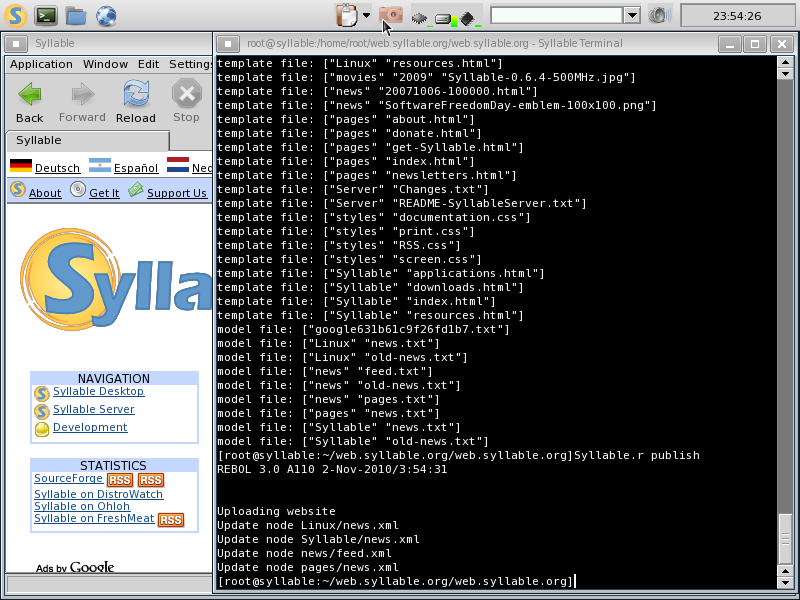
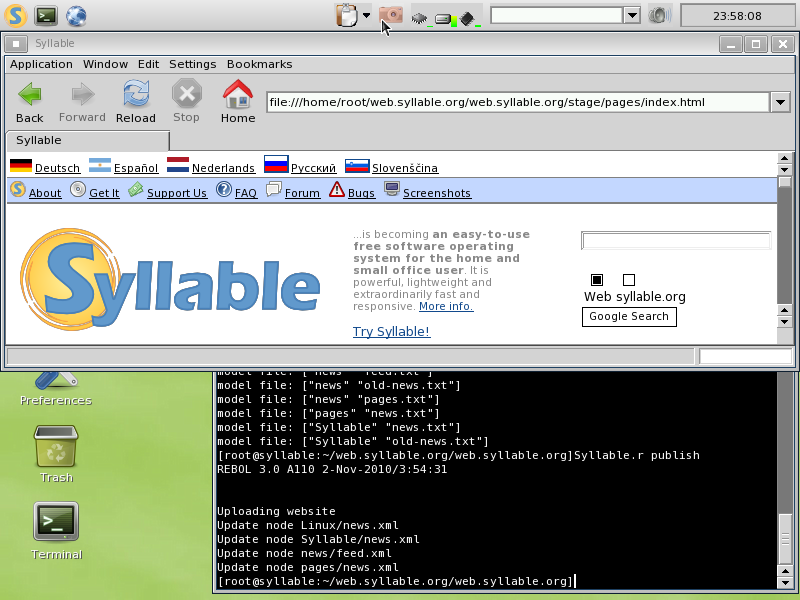
The CMS that builds the Syllable websites was used on Syllable Server so far, but has now been ported to Syllable Desktop. This was done by porting it to REBOL 3. This screenshot shows Desktop building its own website in static batch mode and synchronising it with Amazon S3. This screenshot shows the Webster browser previewing the built site as local files. Building the websites on Syllable Server is around 35% faster with REBOL 3 than with REBOL 2. A few longstanding problems in the Russian website and Syllable documentation were fixed because REBOL 3 now understands Unicode.

Politics Affect Operating Systems Too

I know that there's a number of readers who don't like it when OSnews covers political topics, I'm one of them. These political upheavals however spell danger for operating system hobbyists and so I dedicate this article to framing the political news within the context of what we are here to read about: operating systems.