Because of Haiku's new building system it is now possible to cross-compile Haiku on Linux, and Ghostride (Who submitted the story) has documented how he Cross-Compiled Haiku on his blog.
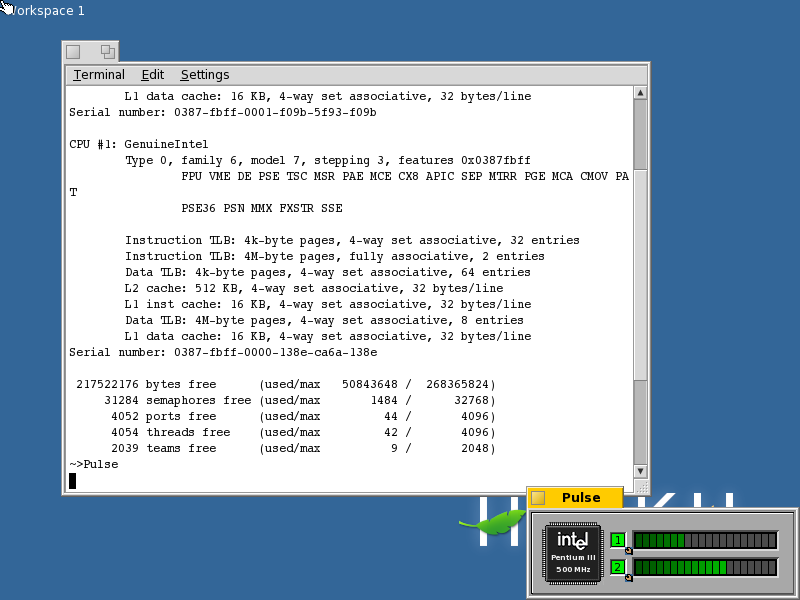
After being broken in Haiku for quite a while, Axel Dorfler has fixed SMP: "Our SMP configuration is pretty weak right now - it only supports virtual-wire mode which is only one of two possible modes every compatible IA-32 MP system should support." There's even a screenshot to prove it.
Here is a very serious offer from Andrew Edward McCall for any PowerPC programmers out there. He is offering a Laptop to anyone that can port Haiku to the PowerPC platform. "Haiku on PowerPC isn't going anywhere, this is due to me being unable to patch gcc and not having enough time to work on it. If anyone has time and experience and would like to work on porting Haiku to the PowerPC architechture, but needs equipment, I will send them out a Apple 'Wallstreet' PowerBook G3 to work on for free."
It has taken Axel Dorfler five days to get Haiku to boot from CD. "I successfully booted Haiku from CD-ROM from several machines today. It took a bit longer than I thought, as no emulator that I have access to seems to support multi-session CDs, and not every BIOS I have works by the book. Anyway, you could build you own bootable CD image with the "makehaikufloppy" script that's now in our top-level directory."
Due to user donations, Haiku, Inc. has enough money to pay Axel through to at least the end of November, as a full, 40-hour-a-week employee. He has also started maintaining a blog of his work.
Donn Cave has updated his port of Python to BeOS, as well as the Bethon BeOS API interface library. This brings BeOS up to date with other platforms with regards to Python, and merges some independent patchsets into Bethon. Both are for R5.03, meaning that pretty much any BeOS system out there can use them.
"After feverishly working throughout 1995, it was finally decided that the results of 5 years of low profile work were ready for a public launch. When one considers that little over a year earlier, Be's entire hardware platform had been made redundant by the demise of the AT&T Hobbit processors, this was a remarkable achievement." Ten years ago, the legendary BeBox computer was introduced by Be,Inc at Agenda '95. Joseph Palmer has put up a gallery of photos of the event.
In this video (.torrent, Quicktime) "you will see great attempts at crashing the Haiku app_server, some commentary on the robustness of the code, and a staggering amount of threads for Java running on BeOS R5." Here is more about the video.
Got some spare time and an itch to try out the latest Haiku snapshot? Karl writes in with an easy install method for anyone wanting to try Haiku, using a BeOS Max Live CD.
Over at IsComputerOn, an article discusses with Axel Dörfler, the Haiku move for the FreeBSD network stack. Also talked about is the thought of using ReiserFS instead of BFS.
Two BeOS tutorials have been released. The first one explains which settings to use with WonderBrush when working on icons. It is available in English, Dutch and German. The second one is a complete set of instructions on how to get the unique im_kit working. This one is available in English and Dutch.
Today the latest SVN checkout of Haiku sources gave us very good news: app_server can now run Tracker (screenshot 123), although it crashes so often that it is actually unusable. You can check this yourself by downloading a Haiku image from Philipp Schmid's blog and running it in Virtual PC (or VMWare). This news is a sign that Haiku is near alpha release.
When BeOS was still under active development at Be Inc, the project captured the hearts and minds of many who wanted to use a more advanced operating system. Though Be has since gone out of business, it hasn't stopped many of those same individuals from wanting to continue using the operating system. The fact that BeOS is no longer under active development has caused a handful of developers to take on the task of picking up where Be left off. Alan Wilder submitted the following editorial which analyzes the current status of three BeOS projects that are currently under development.
WalterCon 2005, the second annual North American conference for Haiku developers, users, and enthusiasts will be taking place Saturday, August 6, and Sunday, August 7, 2005.
Mesa3D has been imported into the Haiku sourcetree: "A first draft of Haiku's OpenGL kit started his life yesterday when I've imported large portions of Mesa3D's BeOS port into our source tree."
DarkWyrm reports (via his blog) his team has been hammering away at the app_server and making serious headway. Not only does the app_server sport nifty new code to solve clipping issues, but the BMenu classes have a ton of fixes for previous crashing issues, and Stephens Playground app has some cool tricks added.
Unfortunately only available in German language, Technoids is the only independent magazine reporting about BeOS(HAIKU) and ZETA constantly. In the seventh issue you will find an interview with Michael Phipps from HAIKU, a ZETA R1 preview, a review of yellowTABs ZETA PC and a lot more. You will Also find an in depth footage covering Apple's Garageband 2 and some other articles regarding other operating systems. So at last a lot of Be mixed with interesting Stuff from other worlds. The magazine (free PDF) can be found here.
HaikuNews has a screenshot of a test app running on the Haiku app_server (under R5, but does run under Haiku itself the same) using alpha blending and a number of interface kit widgets - buttons, radio buttons, text boxes, and textfields.
According to HaikuNews, new open source nVidia 3D drivers are now ready for BeOS. Included are screenshots of Be's 1999 era Quake II port running unmodified and 3D accelerated.