Review: Inspiron 1420n with Ubuntu

Ars reviews a Dell Ubuntu laptop, and concludes: "The Dell Inspiron Notebook 1420n with Ubuntu preinstalled delivers software freedom and solid value. For serious Linux enthusiasts who are already comfortable handling the various idiosyncrasies of the platform, Dell's preloaded Ubuntu laptop is a practical and cost-effective choice that eliminates the need to perform a manual installation and provides Linux users with a means of dodging the odious Windows tax. Although I consider this product a strong buy for experienced Linux users, I don't recommend it (yet) for users who aren't already familiar with the operating system. Ubuntu's prodigious ease of use is diminished by a litany of frustrating minor hardware support problems that many average computer users will not be inclined to resolve."

The House of the Future

Remember those great "home of the future" demonstrations from days past? If you're not old enough to remember them from world fairs, Disneyland, or movie newsreels, you've probably seen the cartoons parodying them: Robotic maids, self-cleaning kitchens, futuristic-looking plastic furniture, dehydrated food; everything white, round, and sparkling. Well, it's the future now, and it didn't exactly turn out the way they thought it would, but thanks to ubiquitous computer technology, today's home can have capabilities that futurists 50 years ago would never have imagined.

Ubuntu 7.10 Released

Ubuntu 7.10 has been released. "Ubuntu 7.10 Desktop Edition adds an enhanced user interface, improved hardware support, multiple monitor support and integrated desktop search. Ubuntu 7.10 Server Edition features improved functionality, manageability, pro-active security and hardware compatibility and delivers a rapid deployment platform for developers and businesses. New versions of Kubuntu and Edubuntu, derivatives of Ubuntu aimed at KDE enthusiasts and the education community respectively, are also being released at the same time." And a review. Update: One more review.

KDE 4.0 Beta 3 Released

The KDE Projects is announcing the third beta of its future KDE 4.0 platform. "This Beta has mostly been focussing on finalizing the design of the libraries in preparation for the release of the KDE Development Platform. Yet, many user-visible changes have gotten in as well. While new features and usability improvements were added, bugs were found and fixed in KDE and the stability of Beta 3 has improved much compared to the previous Betas. With the third Beta, the KDE project has begun to finalize KDE 4.0."

‘Linspire 6: Two Steps Back’

"Former Linspire CEO Kevin Carmony was pretty gung-ho about the company's upcoming release back in June. He said it would 'fill some key holes in our current offering'. Unfortunately Linspire 6, released last week, lacks the refinements you'd expect in a distro you pay USD 50 to download. It drops some key distinguishing features, and in return gains only some Microsoft technology as spelled out in the Microsoft patent covenants Linspire agreed to. This release seems to be about deferring to Microsoft."

Nokia Announces the Nokia N810 Internet Tablet

Nokia today introduced the Nokia N810 Internet Tablet, signifying a new phase in portable internet communication. Sporting Bluetooth 2.0 and Wi-Fi 802.11b/g connectivity, a slide-out QWERTY keyboard and a full-fledged web browser, there's only one thing missing: WiMAX. However, a WiMAX version of the N810 will be coming next year. In the meantime, the N810's Wi-Fi connectivity will provide Internet access through hotspots as well as home and office networks, including via Boingo Mobile. Applications compiled for the previous two Internet Tablet models will not be compatible with this one. This hurt the N800 a lot too, because most developers didn't care to re-compile their apps as they kept their N770. Hopefully this is the last time Nokia breaks compatibility.

KDE 3.5.8 Released

The KDE team has released KDE 3.5.8, a maintenance release. New stuff: "Improvements in Konqueror and its web browsing component KHTML. Bugs in handling HTTP connections have been fixed, KHTML has improved support of some CSS features for more standards compliance. In the kdegraphics package, lots of fixes in KDE's PDF viewer and Kolourpaint, a painting application, went into this release. The KDE PIM suite has, as usual, seen numerous stability fixes, covering KDE's email client KMail, the organizer application KOrganizer and various other bits and pieces."

Review: Mandriva PowerPack 2008.0

"Mandriva Linux has a history of inconsistency; one release will be superb, and the next one will be so bug-ridden and feature-weak that it's unusable. The only commonality among all releases are the excellent system configuration tools, which have continued to evolve over the years to match an increasing level of complexity in the desktop software stack. True to form, Mandriva 2008.0 is an excellent release, following the terrible 2007.1, and the just as excellent 2007.0. Some of the important things that were dropped from the previous release (Cedega, LinDVD) are back, and some of the problems (huge K menu button, cluttered menus) have been mitigated."

Project Indiana Release Brings New Package Manager

Project Indiana, Sun Microsystems' Linux-like OpenSolaris effort, will begin shipping to developers before the end of October, the company announced Oct. 15 at its open-source summit press event here. The developer release will include Image Packaging System, a new package manager slated for inclusion in the next version of Solaris, but won't be back-ported to Solaris 10, the most recent version to ship, said Ian Murdock, Sun's chief operating systems platform strategist, in an address to the media. All of the technology developed under Project Indiana will be delivered through OpenSolaris going forward, he said. The full release is expected in March. More here.

Asus Launches Eee PC

Asus has formally rolled out its Eee PC line of sub-notebook computers, a week after UK supplier RM - formerly Research Machines - spilled the beans on two of the models. The complete line-up comprises four computers. All four models are based around the same 7in display; 900MHz Intel Celeron processor and chipset; 10/100Mbps Ethernet port and 802.11b/g Wi-Fi for internet access; HD audio; three USB ports; SD card slot; stereo speakers and microphone input; and a version of the Linux open source operating system, Xandros. My take: I want one. It has everything I need: small size, Linux, wireless, and email client/browser/IM. I don't need more from a laptop.

Syllable Server Emulator Images

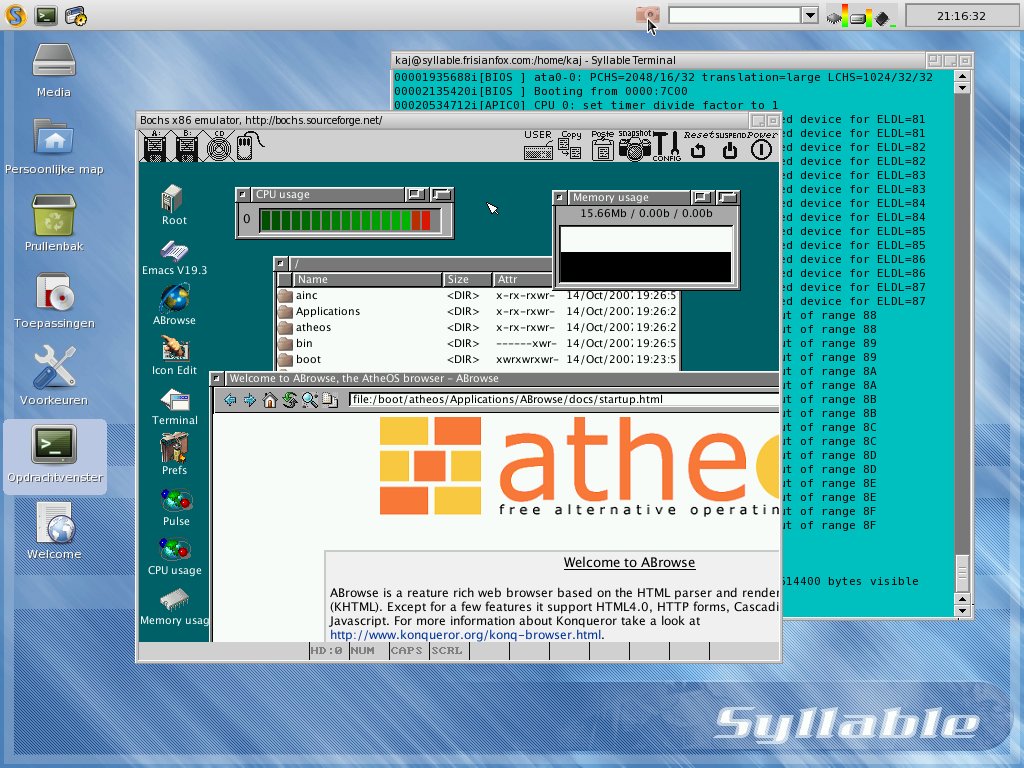
The Syllable project has published the first two preconfigured virtual machine images for trying out Syllable Server without installation. One is for VMware . It can also be used with QEmu and VirtualBox. The other is for other emulators such as Bochs, or also QEmu . The latter unpacks to a file of one gigabyte. Detailed instructions are here. Also, for history purposes, two images were published of the last version of AtheOS, Syllable's predecessor . Here is a screenshot of AtheOS running on Syllable.

‘Home Is Where My Server Is’

"When Microsoft announced Windows Home Server earlier this year, it was greeted with a mixture of curious disdain and eagerness. Some questioned what the product offered over existing solutions, while others welcomed it with open arms. It's at once hard to explain and easy to understand what Windows Home Server is, but it's worth getting to know the newest addition to the Windows family."

Red Hat Global Desktop To Appear in November

"When Red Hat announced its upcoming Linux desktop at its annual summit in May, the company predicted the Red Hat Global Desktop would be out by September. Now, delayed a bit, the new desktop Linux will be appearing in November, company executives are saying. The delay was caused, Gerry Riveros, Red Hat senior product marketing manager for enterprise Linux, said in an exclusive interview with DesktopLinux.com, by Red Hat's desire to support Intel's full PC hardware platform lines."