When I wrote about using Windows 11 for a month as part of the ongoing OSNews fundraiser (keep donating to get me to do the same for macOS!), one of the things I mentioned was that “the modern desktop context menu has its own classic Win32 context menu”. This is, in fact, a long-standing complaint I’ve repeatedly used as the perfect example of just how chaotic and low-quality Windows has become. Thankfully, and naturally I fully attribute this to my repeated complaints (*), Microsoft has been working on a brand new, faster, configurable context menu, and Neowin actually reviewed it.
If you ask me, this revamped context menu addresses just about the biggest problem users had with the one in Windows 11, and that is the need to click through more buttons than necessary to do simple things like renaming a file or opening its properties. That problem is now basically gone.
I have no issues with the new design. It looks modern, it feels more consistent with the rest of Windows, and even though all the new sections can still make it look a little busy, you now have the option to make it as simple or as button-packed as you want. That should cover most use cases and preferences well. I’d even say that when the new context menu becomes available to everyone, my guide on how to bring back the classic context menu might become obsolete.
The biggest reason I’m linking to this is not because I care about whatever monster of a context menu Windows users are having to deal with. No, I’m only linking to this because I never in my life imagined I’d be linking to a review of a context menu. I mean, at least it’s not the chess application icon. That would be embarrassing.
A great and concise history of the run-up to MS-DOS 2.0.
Yet, there was a nagging feeling that a single-tasking CP/M clone was inadequate for the new generation of personal computers. Digital Research released multi-user, multitasking MP/M-86 in September 1981 and announced the single‑user multitasking Concurrent CP/M in early 1982. In response, Microsoft came up with a plan for tiered approach to its operating systems: single-user/single-tasking MS-DOS at the bottom; multi-user/multitasking XENIX at the top; and in the middle, something called XEDOS: a single-user version of XENIX. This “pyramid of upward-compatible operating systems” was announced in a Byte Magazine editorial in January 1982.
I’ve always found this tiered approach fascinating, and the world surely would’ve looked quite different had Microsoft been able to make it work. I doubt Windows NT would ever have existed, and most of the world would probably be running a XENIX-based Windows today (all else being equal, which is of course unlikely and silly). Regardless, MS-DOS 2.0 contained a few UNIX-like utilities to deal with its brand new support for directory trees and other new features, and even had a /dev directory.
If you thought pervert glasses weren’t bad enough, Apple is taking it up a notch by adding cameras to its AirPods.
Apple is working on camera-equipped AirPods that appear to be nearly ready to launch, based on a video MacRumors found in the macOS Tahoe 26.7 release candidate.
In a short demo, a man holds a book up so the camera in the AirPods can see the title. “With Visual Intelligence, your world becomes savable. See something you like? Just ask me to save it for later,” says the voiceover text.
AirPods are tiny. I’ve seen people use them at the gym. I’ve seen them on playgrounds. I’ve seen them around swimming pools. People use them at the beach. They’re used at schools. In locker rooms. Tiny cameras in tiny AirPods that can photograph anything in front of the user are a pervert’s wet dream. Abusers are going to love this. Why wear bulky glasses anyone can see and try to demand you take off, when you can wear tiny AirPods that have already been fully normalised in society? Was there not a single woman or parent on the team that made this?
All over the United States, people are destroying Flock surveillance cameras. More and more communities are rising up and demanding these things removed from their streets and neighbourhoods. The awareness of just how pervasive mass government surveillance has become is growing, and Silicon Valley’s complicity is not exactly a secret. And in this climate of rapidly growing concern and anger, Apple is going to add tiny cameras to its tiny AirPods. Was there not a single person of colour or protester on the team that made this?
How detached from reality do you have to be to greenlight something like this? Does anyone – regardless of skin colour, gender, or political leaning – want even more cameras around them?
I was around when Quake was launched, but I was entirely unaware of this story.
By June 1996, after three years of hard work, id Software had completed their next title, Quake. As for their previous title, they were going to release both a shareware version and a full version of their game. Since it used a mere 22 MiB of storage, people at id Software had the idea of leveraging the remaining capacity of a CD-ROM. Why not include encrypted versions of the full id catalogue of games? Not only this would cut out the middlemen, it would give instant access to gamers with a simple phone call and a credit card.
The concept was implemented. The CD was announced on July 3, 1996 and released on August 30th[5]. The hacker group GNOMON released Quakecrk.zip only 39 days later. The archive contained QCRACK.EXE, a tool allowing to decrypt every single game on the CD-ROM.
The system id employed turned out to be incredibly primitive and simple, and hackers found out quite easily that the system required no secret sauce from id at all – the code you’d get over the phone contained no secret, and all the validation program on the disk did was check to ensure the code received over the phone matched the code generated by the disk.
No wonder it took them only 39 days to crack this.
Earlier this year, Natalie Vock made a splash with a set of patches to the Linux kernel that greatly increased performance on AMD GPUs with lower amounts of VRAM. With that work now accepted by upstream, Vock decided to turn their attention to another interesting problem: what if you run out of VRAM, and how can we improve performance when we do?
Regardless, what I hope this blogpost can demonstrate is that even if you end up with some memory evicted to system RAM, the slowdown can be manageable. There’s measures that drivers (particularly, the kernel driver) can take to make overcommit work as fast as possible, and even applications can do their part in coordinating with the driver stack to mitigate the effects of their memory being evicted. With everything in place, VRAM overcommit isn’t really as big of a deal as one may think it is at first sight.
The work Vock has done has already been in SteamOS for a while, and they’re currently in the process of upstreaming it to the vanilla kernel as well. Since this is a complex set of patches and changes, this may take a while, and as such, they’ve prepared custom kernel and Mesa branches for adventurous users. Do note that these branches won’t be maintained much, and are entirely experimental, not as well-tested as the SteamOS kernel, and probably won’t yield the same performance improvements.
Still, this is the kind of work that has a material impact for users. Not everyone has a 16GB monster GPU, especially not today with supply chains ravaged and ruined by slopmakers, so it’s great to see the Linux world working to improve performance for everyone, not just the wealthy few.
The Touch Bar arrived in 2016 seemingly already pre-doomed, on a generation of machines that had a “we’ve run out of ideas” smell all around them. The arrow keys were reshaped, the keyboard got a slimming down, and even the beloved MagSafe wasn’t, in fact, safe. All of these changes would prove unpopular and get reverted in time, and the axe would eventually come for the Touch Bar, too.
With an enormous benefit of hindsight, a decade after its arrival, and on the (rumored) eve of fully multitouch MacBooks, I wanted to look critically at the Touch Bar in more detail. I put a spicy title above this post, and while I’m not sure I can answer it in the affirmative, I feel I got surprisingly close to that.
I have never spent this much reading about and pondering a technology seemingly nobody liked and that I never really used. I still think there’s merit to the idea of screen on a keyboard, but only if the screens are integrated into the individual keys (as some products have tried over the years). Of course, this would also be astronomically expensive, delicate, and virtually impossible to repair, so I’m not sure something like that can be reasonably made at an affordable price.
Version 7.2 of the Linux kernel has been released.
Significant features in this release include common attributes support in the bpf()vsystem call, cache-aware load balancing for the CPU scheduler, large-folio support in the Btrfs filesystem, further swap subsystem improvements, improvements to the Landlock security module, support for block devices with inline encryption hardware via the dm-inlinecrypt device-mapper target, and much more.
We talked about the latest release of Delphi a few days ago, and that brought me to Hans Otten’s website.
This site is about my experience with the Wirth school of languages, based on the ideas and implementations of Prof Niklaus Wirth, Kenneth Bowles, Per Brinch Hansen, colleagues, and their students. And my experience with the various variants, from the P2 and P4 compilers originating in Zürich ETH, via UCSD Pascal P-System to the Borland compilers and Modula and Oberon systems. All applicable to small computers and device control.
On this website you will find information on Pascal for small machines, like Wirth compilers, the UCSD Pascal system, many scanned books and other files on UCSD Pascal, Pascal on MSX and CP/M, Delphi programming on PC, Freepascal and Lazarus on Windows and Raspberry Pi, Oberon systems. Many sources of early Pascal compilers! And last but not least my Pascal-M system!
One of the most surprising aspects of the Nix language is that it is lazy, especially if you have never used a lazy language before. This laziness is what makes much of Nixpkgs possible, and its complexity.
[…]
I decided to take that idea and make the attribute path a sequence of button presses in Super Mario Bros. 3. Each node in the tree is a frame of the game, and each child is a button press that produces a new frame. Game states are recursive by nature.
Today, you can get low-quality knockoffs of just about any popular smartphone on sites like AliExpress or Temu, whether they be iPhones, Galaxy phones, or whatever else. They have terrible build quality, bottom-of-the-barrel components and specifications, and all run outdated versions of Android – badly. At the same time, various consumer electronics brands, once popular in a bygone era, sell the rights to their brand name to unknown companies, who then put these brands on generic hardware to give their products a sheen of legitimacy. That’s why today, you can still buy Nokia smartphones, Polaroid cameras, and low-effort Hi-Fi equipment from various once-respected brands.
None of this is new, however. In the late ’90s and early 2000s, companies were already doing the same thing. In fact, there’s one device from this era which combines both business practices – it’s both a cheap knockoff of a wildly successful device, and it carries a once-revered brand name. Also, just to add some juice, this story involves stolen source code.
Let’s take a look at the worst PDA of all time, the Olivetti daVinci.
€5000 incentive: Make me use Windows 11 for a month (the results were not great) > €10000: Video tour of my office and my computers/devices collection < €15000: Buy a Mac and use macOS for a month (and review it) €20000: I get an OSNews tattoo
In 1997, Palm launched the Palm Pilot, and it and its successors proved to be a massive hit. Where countless before it had failed, Palm found the magic formula to make pocket computing work. I wrote an in-depth article about Palm over 13 years ago which goes into much (much) more detail, but the reason the Palm Pilot succeeded where things like the Newton, PenPoint OS, and Windows for Pen Computing failed, is that Palm’s founder, Jeff Hawkins, realised that they were competing with paper, not with desktop computers. Instead of trying to shove the capabilities of a full personal computer into a (barely) pockatable device, a pocket computer had to be as fast and convenient as paper, and therefore extremely strict about which features to add, and which to omit.
To this day, the entirety of smartphone computing stands on the shoulders of Palm. Palm’s ideas, implementations, approaches, paradigms, and even people were absorbed by Apple and Google, where they shaped both iOS and Android. The phone you’re looking at right now has a ton of Palm DNA in it, still. After all, you’re still using the homescreen-with-apps paradigm Palm already perfected in the late ’90s and early 2000s.
The success of the Palm Pilot and its successors did not go unnoticed. Microsoft, most prominently, felt incredibly threatened by Palm’s success:
The success of Palm’s products got the attention of Microsoft, and the company pretty much announced it was going to crush Palm. According to Hawkins, Microsoft had a sales conference, where, at some point, a big target appeared on the projector screen, with the Palm logo dead in the centre of it: “we are going to crush and kill these guys”, was the central message. Hawkins recalls that he got condolence letters after that, stating things like “Sorry Jeff. Too bad.”
While Microsoft proved to be unable to “kill and crush” Palm, it did manage to build a relatively successful business selling PDAs running various incarnations of Windows CE. Together, Palm and Microsoft dominated the PDA market pretty much throughout its entire existence, and while the market was a mere fraction of the smartphone market of today, other companies still wanted a piece of this pie too. One of these companies was Olivetti, a storied Italian company with a long history making typewriters, computers, and other electronics.
I’m not going into detail about Olivetti’s history, but the company was renowned for its attention to design, creating iconic products like the Lexikon 80, Lettera 22, Elea 9003, Programma 101, and so, so many more. Olivetti also entered the personal computer market, first with a variety of custom machines featuring Z80 and later Motorola 68000 processors running a variety of custom operating systems developed by Olivetti (including its own UNIX variant, X/OS). After a few machines using MIPS and Alpha processors in the early ’90s, the company would eventually focus entirely on Intel-based PCs (including this amazing failure) running Windows. Like so many other computer makers from that era, Olivetti eventually left the PC business by selling it off in 1997.
To this day, Olivetti PCs tend to cost more on the used market than those from other brands, despite no technical merits dictating so.
At around this time, our current story begins. Seeing the success of the Palm Pilot and the emergence of copycat devices running Microsoft’s Windows CE, Olivetti wanted in on the action. And so, in the late ’90s, the company introduced the Olivetti daVinci, a line of PDAs whose software looked suspiciously like Palm OS. There’s not a ton of information out there about the development history, but it seems that while Olivetti designed the hardware, it contracted the development of the operating system out to a company from Hong Kong, Echolink Design.
And this is where things went horribly wrong for Olivetti. The software Echolink Design developed for the daVinci didn’t just look like Palm OS, it was Palm OS – at least, according to Palm. After being on the market for about a year, the Palm Pilot maker, then a subsidiary of 3Com, filed for an injunction, alleging that the daVinci operating system designed by Echolink Design contained actual Palm OS source code. In addition, Palm also filed suit against CompanionLink Software, the company that developed the Outlook synchronisation software for the daVinci. Palm won handily, and within a day of the filing, temporary restraining orders were put in place on both Olivetti and CompanionLink, stopping sales of the daVinci and its software dead in its tracks.
It seemed to have been a pretty clear-cut case. From The Wall Street Journal at the time:
U.S. District Judge James Ware ruled Olivetti’s Royal daVinci organizer contains software that appears to have been copied from the operating system for 3Com’s Palm organizers. Judge Ware said a review by a software expert found the daVinci software contains private Palm code and even grammatical mistakes that appear to have been “copied verbatim.”
It’s difficult to ascertain what code, exactly, was stolen, but my personal educated guess is that it probably involved Palm’s unique Graffiti handwriting recognition system. Graffiti actually predates the first Palm Pilot, and was available on a variety of non-Palm devices; it doesn’t seem entirely unlikely to me that the code for it escaped containment that way, eventually finding its way to Echolink Design. I’m just guessing here, though, as I can’t seem to find any of the original court documents concerning the case.
In a bind, Olivetti claimed the copied code represented less than 2% of the operating system’s code, and set about to release a new version of the software for the daVinci.
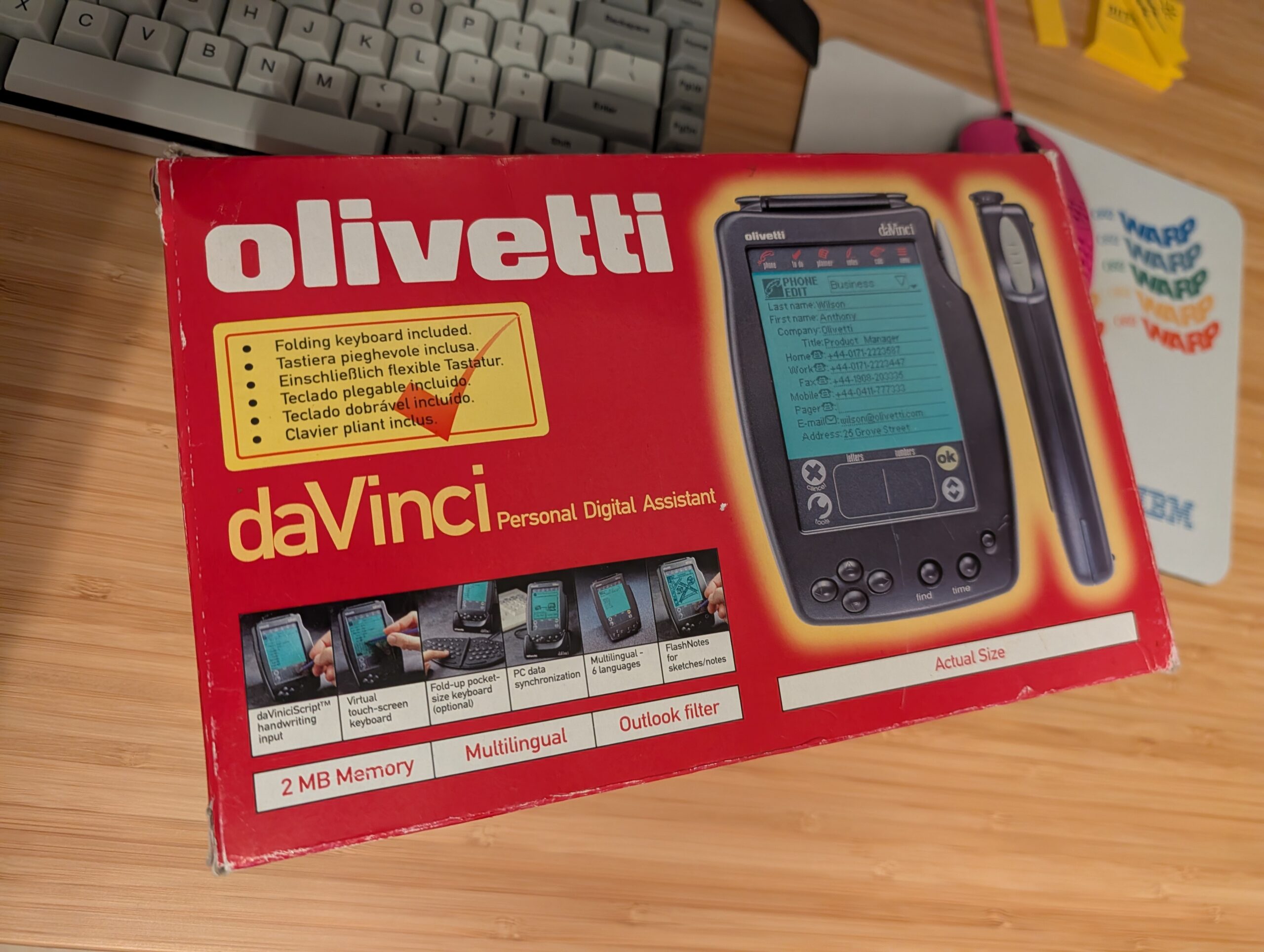
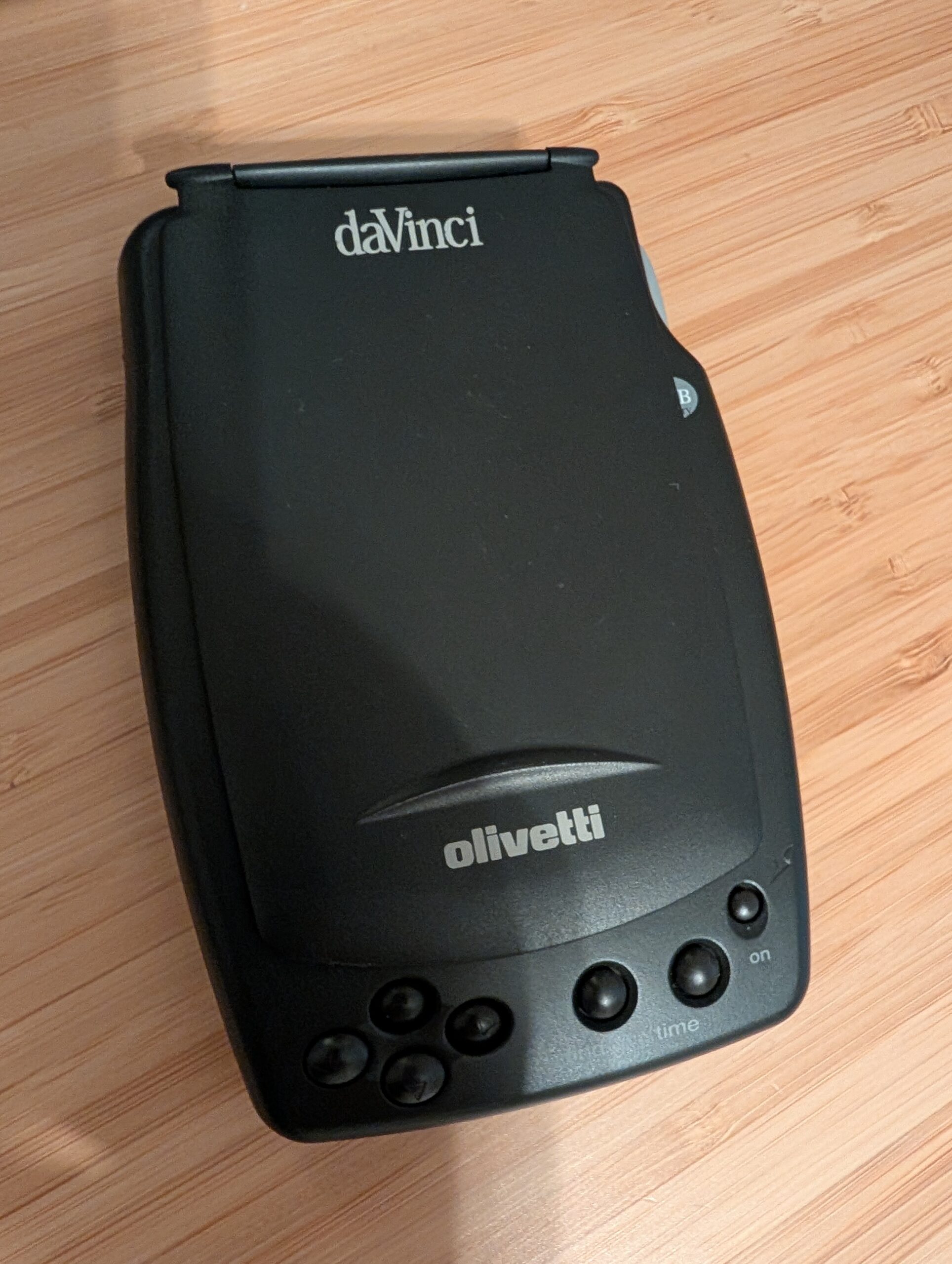
And so we end up at the device I have in my collection. Several years ago, I bought a boxed version of the Olivetti daVinci DV3, including all of its original accessories for a pittance on eBay, and I’ve been fascinated and repulsed by this device ever since. It looks like a cheap Palm knockoff, and it feels like one too; the hardware is made out a really unpleasant form of plastic, with buttons worse than what you find on the cheapest possible pack-in remote control. The case feels creaky and unrefined, like the cheapest possible children’s toy.
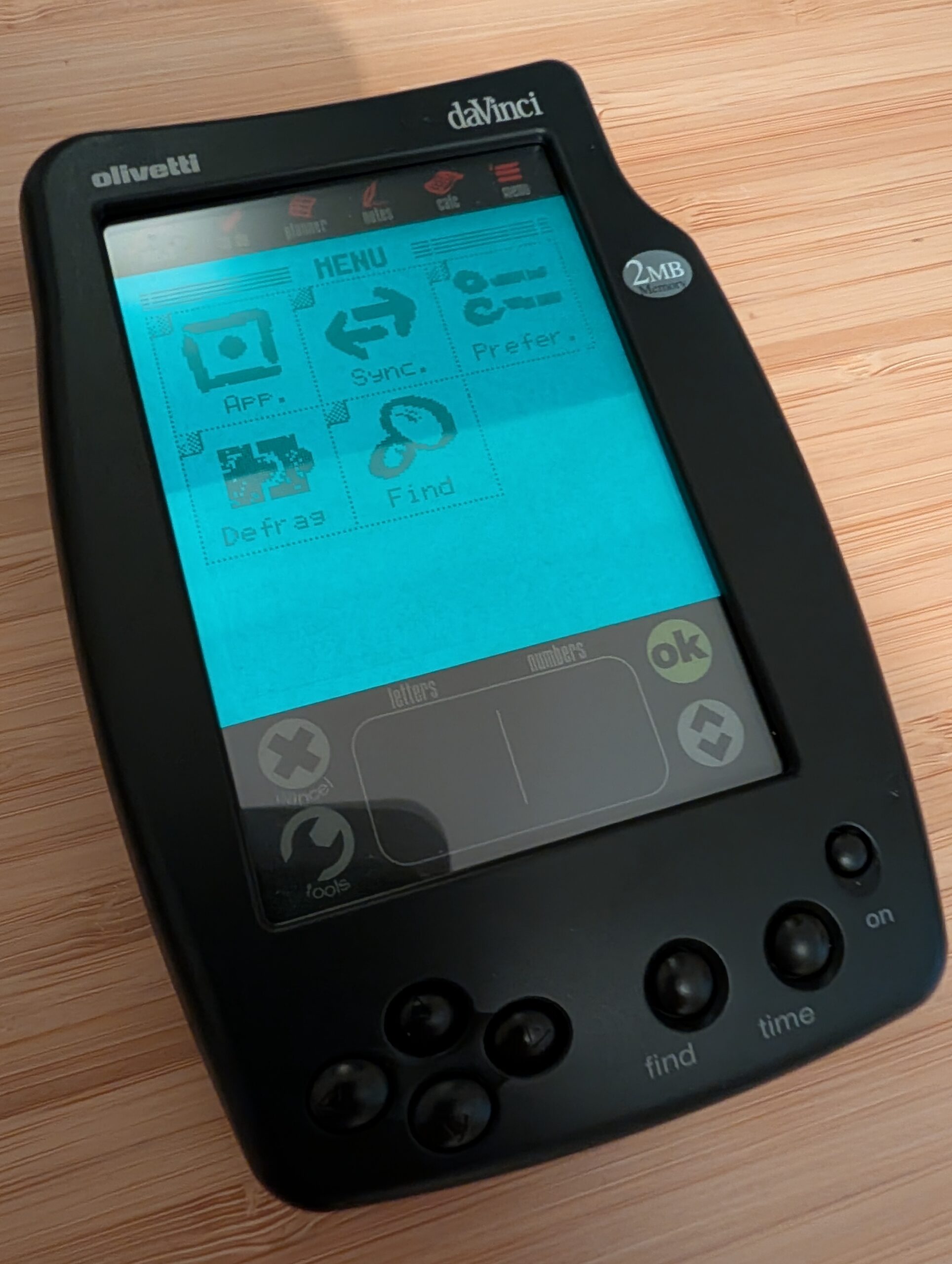
The display has a resolution of 128×99, much lower than the 160×160 of even the first Palm Pilot, and it’s incredibly dim and hard to read without the backlight on; even with the backlight on, it’s difficult to read anything. Worse yet, the various hardware tap targets on top of and at the bottom of the display are not backlit at all, making them unreadable in all but the most illuminated environments. Considering you need these buttons a lot, it’s a major stumbling block. Turning on the backlight is confusing, too, as it you need to hold down the on/off button (while the display is on) to engage it, something only mentioned in the manual.
The display is, of course, a resistive touchscreen, as was the norm at the time, but its precision seems much lower than anything Palm ever offered. The accompanying stylus, too, is plasticky and cheap, definitely worse than the plastic styluses Palm shipped with its earlier models, and obviously no match for the metal styluses that would accompany later models.
Finding out exactly what type of processor the daVinci DV3 uses is remarkably hard. A contemporary review by Smart Computing claims it’s using an unspecified Epson processor, without giving any further details. There’s only one source that specifically states what processor it has, and considering that source is the only person to have written a third-party application for the DV3, I’m inclined to believe they’re right (opening the device up is of no use, as the SoC is of the epoxy blob type). According to them, the DV3 runs on a Sharp SM6010 microprocessor, for which a datasheet and more detailed documentation exists. The SM6010 is a very basic 16bit single-chip microcomputer of an unspecified architecture (probably something custom and proprietary), running at 30Mhz.
The SM6010 is a 16-bit single-chip microcomputer incorporating a 16-bit CPU core, LCD controller, watchdog timer, serial interface (UART, SCI), SIR, PWM output, real time clock, A/D converter and bus controller.
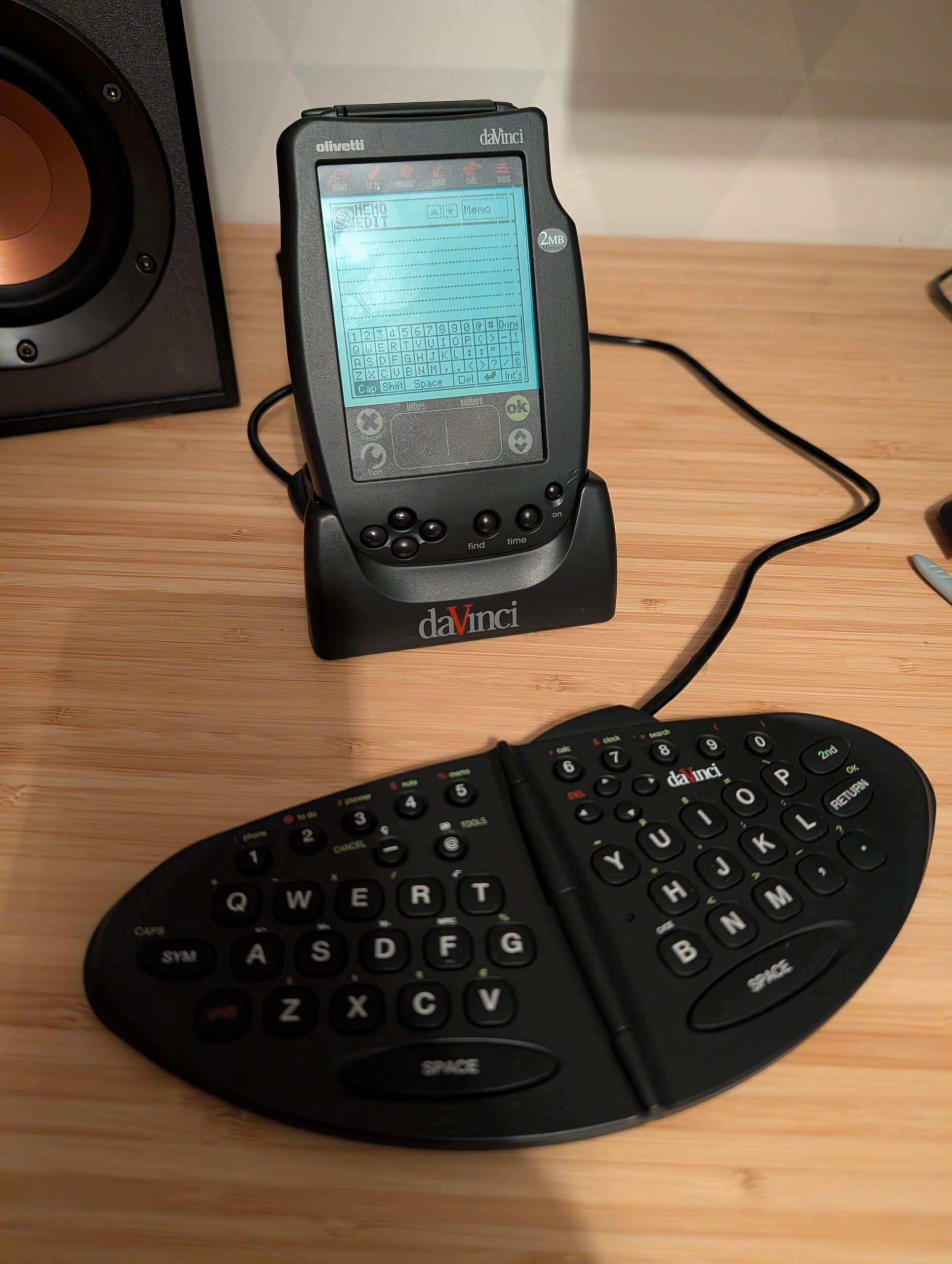
The DV3 stores its operating system in flash memory – making it upgradable – and has 2MB of RAM, stated proudly all over the box and on a sticker on the device itself. Performance is actually not that bad, but it’s not quite as instant and responsive as Palm OS. The operating system and its user interface are rather inscrutable; there doesn’t seem to be a single home screen you can always go back to like on Palm OS, and closing/leaving applications/screens is done differently for each individual application/screen (tap the hardware “OK” button? An on-screen “OK” button? Press the cancel button? Tap one of the hardware application shortcuts atop the display? Who knows!).
The core tools of the DV3 are incredibly basic, and cover merely the bare necessities of a PDA in the late ’90s, with things like an address book, notes application, calendar, calculator, and a few others. There’s no consistency among any of these tools, and they all look, feel, and work just differently enough to be confusing. The daVinci is also Very Serious™, as there’s no games or even a simple drawing gimmick; in fact, while there is a button labeled “Apps.”, it doesn’t actually do anything (we’ll get back to that). There’s barely any preferences to fiddle with either.
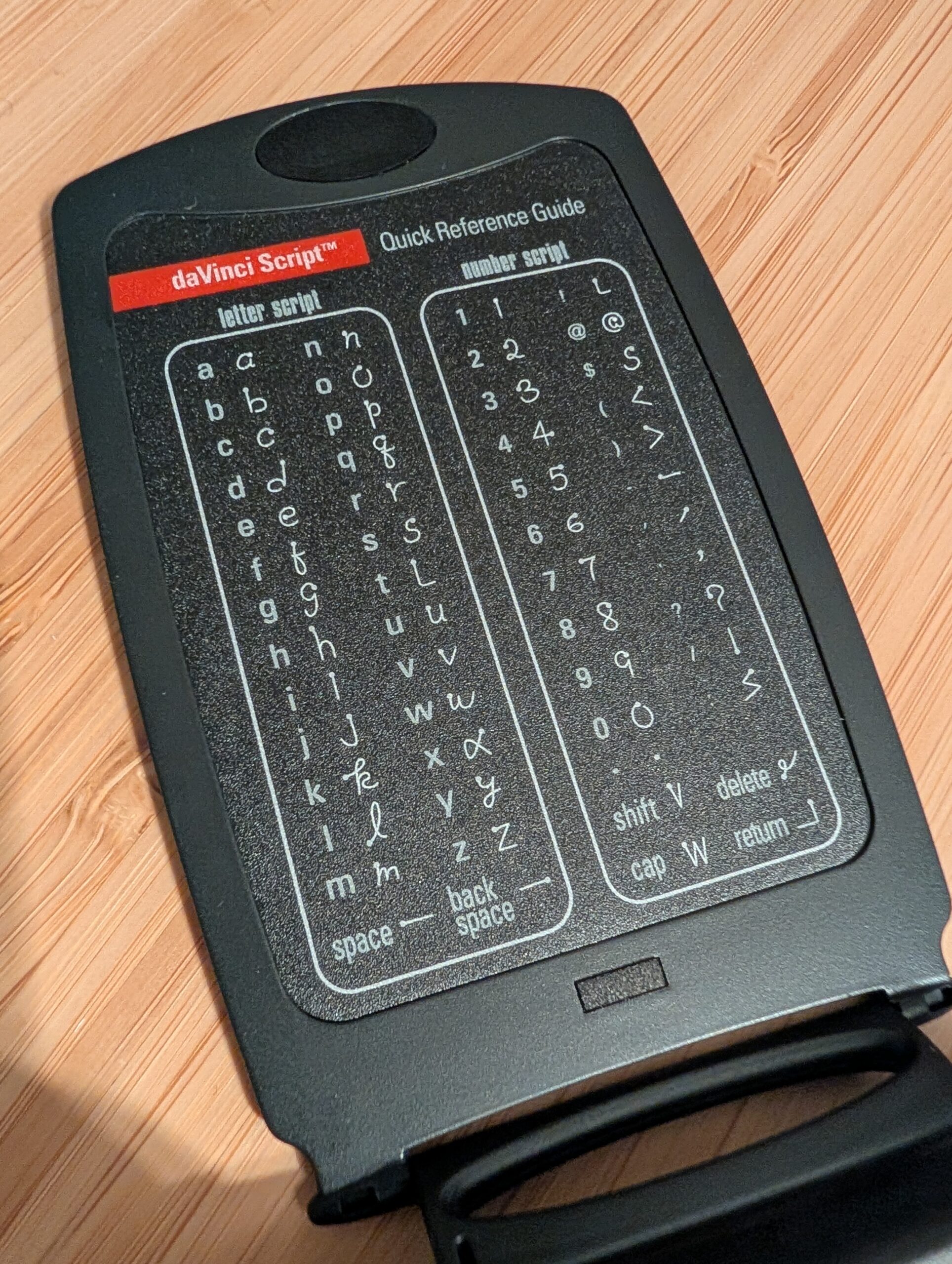
Input is done via a terrible Graffiti ripoff called daVinci Script, which uses strokes much more cumbersome than its inspirator, not aided by the absolutely trash recognition algorithms. This input method is effectively unusable, as it’s impossible to predict which strokes will produce what character or action. Even something as simple as the right-to-left stroke to delete a character is entirely unreliable, ensuring this is more of a random character generator than a text input system. Luckily, there’s a tiny on-screen keyboard you can use to hunt and peck with the stylus, but this isn’t exactly a particularly fast input method either.
It’s hard to convey just how utterly terrible the software experience is, especially in 2026 when many people reading this lack the frame of reference of its time. This isn’t utter trash compared to what we’re used to today – this is utter trash compared to the competing devices running Palm OS and Windows Pocket PC of its time. Even in 2026, I love using Palm OS and Pocket PC, but I absolutely despise, dread, and hate using the daVinci. I’m struggling to find a comparison with something contemporary, but the best I can come up with is like comparing an Apple Watch or WearOS device with one of those cheap knock-off smartwatches that run some shitty custom low-res UI on an underpowered SoC, but honestly, even that does a disservice to these knock-off smartwatches.
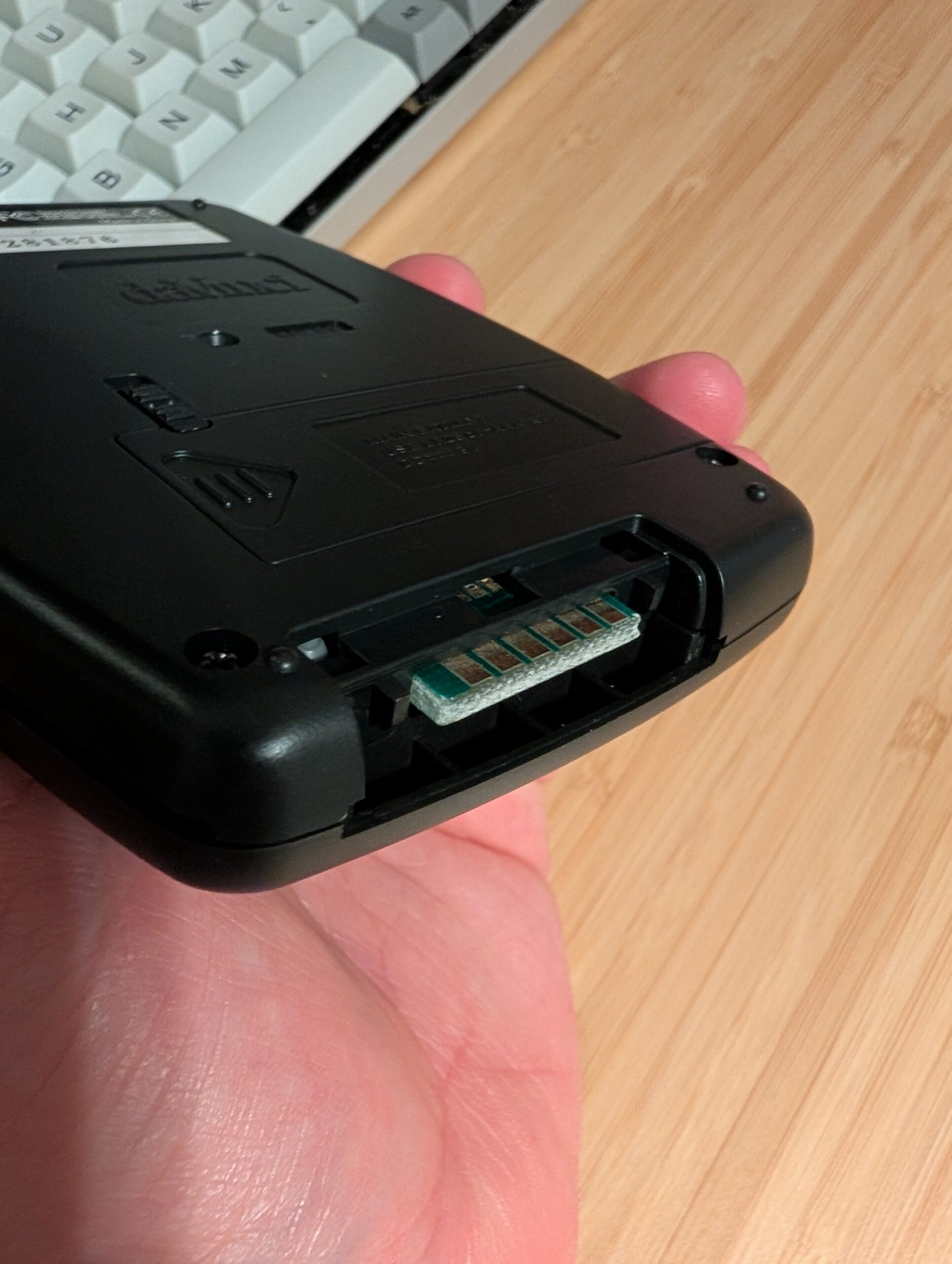
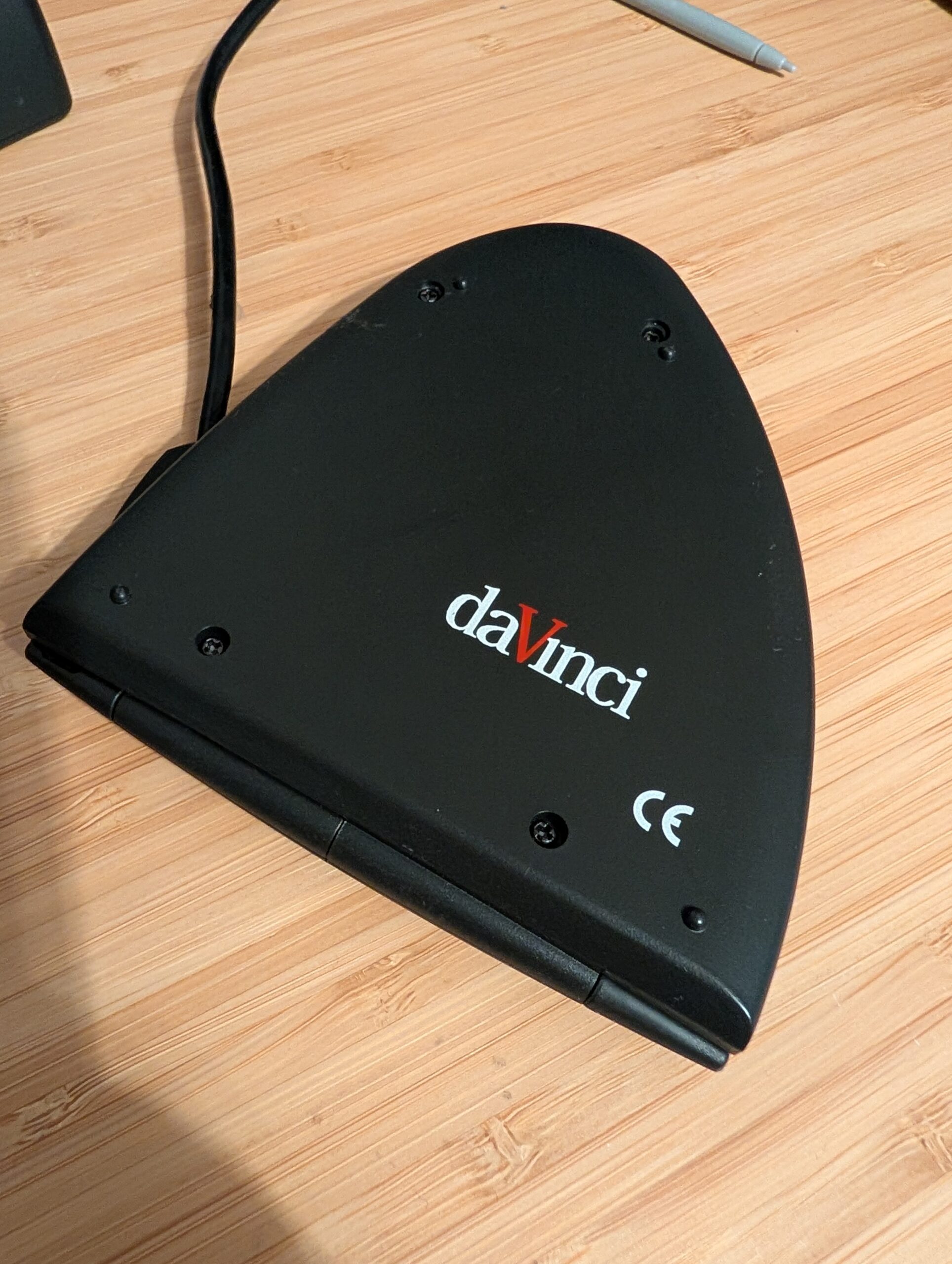
The daVinci I have came with all of its original accessories. There’s a vinyl pouch, a dock, and an external, fold-up keyboard. The pouch has not withstood the test of time, and has shrunk, so much so the daVinci no longer fits inside of it. The dock is, well, a dock, and uses the connector at the bottom of the daVinci. This connector looks and feels exactly like a crunchy ISA slot from the ’80s, as if the PCB was cut off with a hacksaw. The keyboard is the most interesting, and can be connected straight to the device’s bottom connector, or to a passthrough port at the back of the dock. Unsurprisingly, this keyboard is really bad, with dome-shaped mushy rubber keys with very little stability and a featherlight base that moves at the slightest of touches, making it almost impossible to type on.
Thanks, I hate it.
I mentioned the mysterious, non-functional “Apps.” button earlier, and there’s actually a bit of history here. It turns out that Olivetti fully intended for people to write third-party applications for this thing, promising to release an SDK at some point in time. Of course, this never ended up happening as the daVinci is trash and nobody in their right mind bought one or would want to develop for it, but it does mean that somewhere out there, perhaps in an attic somewhere in Ivrea, Italy, there’s a dusty hard drive or CD-ROM carrying this unreleased official SDK.
SDK or no, there’s always someone crazy, skilled, and determined enough to develop something for any computer, and for the daVinci DV3, that person was Alex Zwiesele. Zwiesele figured out that while the official SDK was never released, the CD-ROM that came with the daVinci DV3 contained the entire operating system of the DV3 and a loader program. This was enough for Zwiesele and a few other people to start disassembling the operating system and inject their own custom code into the binary file, reassemble it, and load it onto the DV3 using the loader program.
This was not a walk in the park. Zwiesele documented the entire process on their website, and it involved Zwiesele and several others writing their own disassembler and assembler (still available from their website!) based on the available Sharp SM6010 documentation, as well as learning how to actually program for the device’s hardware. In the end, they managed to develop an actual game for the daVinci DV3, a Breakout clone. You load the game onto your DV3 in the same way you’d load the operating system; as such, the game will replace the entire operating system and load automatically on power-on. That’s as far as they got back in 2003, as efforts seem to have stalled after that.
Back when I bought my daVinci, about 6-7 years ago, I mentioned online that I had bought the worst PDA of all time, without mentioning it by name. Immediately, fellow hardcore PDA enthusiasts (we exist) knew I was talking about the daVinci. This thing is just plain trash, e-waste before the term had been popularised, a waste of everyone’s time, effort, and money. Not even its one redeeming quality – its low price of just $99 compared to the cheapest Palm device at $249 – could make anyone want to use it.
Still, I’m glad I have it in my collection, if only to serve as a reminder that shitty e-waste devices aren’t something exclusive to our current smartphone era. It also serves to underline just how great Palm OS and Windows Pocket PC (yes, I will fight you on this) really were, and how many things they each got right out of the gate. So much so that especially Palm OS laid the foundations for every smartphone we use today.
Now that I’ve finally written and published this article, I can put this abomination back in its box, and never take it out again.
In the last few days, I built a shoot ’em up game by embedding a tiny custom bytecode VM and rendering the graphics using a fullscreen pixel shader. The result is a 3kB Windows executable.
This was done for Langjam Gamejam, a 7-day challenge where you create a programming language and then use it to build a game.
In seven days, Le Brun created a brand new programming language, compiler, bytecode interpreter, a game written in the new language, and rendered it, ending up with a 3kB self-contained executable. It’s amazing what humans can do.
A while back, when chatting with a colleague over their computer, I noticed that a logo did not look exactly the same as it did on mine. It looked thinner on theirs and more faithful to the original image. It was rendered at 15px; here is an upscaled version.
[…]
If you squint, or take a step back, the one from Chrome looks thicker. A bit weird, but swapping the image for an SVG fixed it. Still, I was curious: why was it rendering like this in the first place?
I did some digging and found a nifty optimization that Chrome uses when rendering JPEGs at small scales.
Another month started almost two weeks ago, so we’ve got a new monthly report from Redox, the general purpose operating system written in Rust. The month of July – it seems the report was published with a bit of a delay, regardless of what the date on their site says – brought improvements to the installer, with new options commonly found in most installers, such as a choice of installation method, network-based installation, and more. The Google Summer of Code work on the new CPU scheduler has also been merged, including a number of related performance enhancements.
There’s improvements to the ARM port, Amlogic Meson UART ARM64 support, and uutils grep and sed have been successfully built on Redox, replacing their their GNU counterparts in the os-test test suite. In addition, a whole slew of demos were ported as well, from Ratatui demos to various Iced demos covering things like reading QR codes and processing Markdown. Of course, this is all topped off with the usual long list of lower-level, smaller changes and improvements to the kernel, drivers, Relibc, and more.
€5000 incentive: Make me use Windows 11 for a month (the results were not great) > €10000: Video tour of my office and my computers/devices collection < €15000: Buy a Mac and use macOS for a month (and review it) €20000: I get an OSNews tattoo
We do not run any ads, so we don’t have to be friendly to advertisers (i.e. the technology companies we’re supposed to report on).
We are not owned and controlled by a large media company dictating our tone and content. You’d be surprised how many other sites are.
We do not use any “AI”; not during research, not during writing, not for images, nothing.
We rely entirely on your support to keep going.
I want to make sure I can run OSNews for another two decades and another 20000 posts, and I need your help to do so. Since my wife, who has a tough, underpaid job in elderly care, is largely unable to work due to health reasons caused by that very same job, my income has become a lot more crucial for our kids, my wife, and myself. With OSNews readers being more skeptical of subscription-like things like our Patreon than most people, it’s exactly these one-time donations that make up the bulk of your support.
Raymond Chen explains what, exactly, the file winstart.bat in Windows 95 is used for.
In Windows 95, you could create a winstart.bat file in your Windows directory. During startup, the virtual machine manager initializes and creates the so-called “System virtual machine” (the “System VM”), which is the virtual machine that all Windows programs run in. But before running the user-mode kernel in that virtual machine, the virtual machine manager runs the winstart.bat batch file if it exists.
Chen needs to use several diagrams to really explain what the batch file is used for, but as a very crude summary, it allows you to load TSRs that only apply to Windows programs, while not affecting any additional DOS command prompts you may load later after Windows is already running. While many think it’s a Windows 95 feature, it was already present in Windows 3.x.
A unique feature that I doubt many people made active use of.
Delphi is still very much a thing, and still very much in active development. The current stewards of Delphi, Embarcadero, released the Delphi 13 Community Edition today.
Delphi Community Edition is a full-featured, free edition of Delphi for building native applications with the Delphi language. It includes a professional IDE, visual designers, integrated compilers and debuggers, the VCL framework for Windows development, and the FireMonkey framework for creating native applications from a shared codebase across Windows, macOS, iOS, and Android.
Delphi has been around since 1995, first released for Windows 3.1. It’s both a programming language, a variant of Object Pascal, and the accompanying IDE and related tooling and frameworks, originally developed by legendary company Borland. This latest version of course adds a number of new features to the programming language, and further improves the IDE as well, this time with a brand new 64bit version. The two frameworks for visual application development, VCL and FireMonkey, have also been updated and improved.
Sadly, it’s not open source, and the Community Edition is intended for mostly non-commercial, hobbyist use. If you want to actually earn any money using Delphi, you’re going to have to step up to Delphi 13 Florence, which isn’t free.
The slow but steady march to the grave for the Android Open Source Project continues. Every few months Google hammers another big nail in the coffin of Android as an open source effort, and I’ve documented them all here on OSNews (nail, nail, nail, nail, nail), coming to the conclusion long ago that for all intents and purposes, Android is no longer an open source operating system.
The latest move, however, is just petty.
According to GrapheneOS on [Twitter], Google has apparently replaced public, instant code downloads for Pixel phone drivers with a manual request form. Instead of publishing code directly to open developer platforms where anyone can grab it, Google now requires developers to fill out a Google Form and wait for someone to send them a Google Drive link.
What used to take a couple of hours is now taking weeks.
I’m perhaps misremembering, but I vaguely recall discussions decades ago about what, exactly, it meant to “make source code available”, as open source licenses state in a variety of words. Would mailing a paper print-out by classic post satisfy such requirements? Could you write the source code on a brick and throw it through the user’s window? Could you hire a church choir to sing it? These are all silly examples, but before everyone had internet access, this was a relevant question.
The widespread availability of the internet and software like git solved these issues, which makes it all the more petty that Google now requires an actual application process, waiting times, and Google Drive dumps just to get access to the source code for Pixel drivers. Google is clearly trying to kill whatever’s left of the Android Open Source Project’s rotting corpse, only barely technically complying with any license requirements only because they’re obligated to.
The Android team at Google must be a hoot at parties.
The GNOME Shell user interface has mostly seen minor refinements and quality of life updates in recent cycles, but on the design side we’ve explored a lot of longer-term things we’d like to do. Some of these we have relatively complete plans for, others are more vague ideas that need more research and prototyping. As always, getting things like these implemented depends on developer capacity and interest (and sometimes funding).
While each of these ideas may require additional discussion, prototyping, and testing, we (the design team) have collected them all together here to share our longer-term vision and to give each idea more visibility.
There’s quite a few good ideas in there, with most of them already being available in the form of various extensions. I’m not entirely sure if I’m a huge fan of copying Android and iOS by moving notifications into the quick settings dropdown thing, but it’s not like having them in the clock/calendar dropdown thing is any better. I only use notifications as they arrive and never look at the place where they end up – that’s a mobile thing for me – so I don’t think I’ll really care either way.
Things like editable quick settings, transparent top bar on certain backgrounds, the improved window drag and drop in the Exposé view, the alt+tab experiments, and some of the others do seem quite interesting though, and anything that reduces the number of GNOME extensions I need to install and keep updated gets a big thumbs up from me.
If you wish to work on any of these suggestions, working on GNOME Shell has gotten a lot easier recently.
In the past, GNOME Shell was significantly harder to contribute to and test than apps since you needed to use tools like jhbuild. This has changed in the past year: You can now easily build and test your branch in a nested session from Builder using Mutter Devkit. If you use GNOME OS, you can even build a sysext to install your branch on your host system. This allows daily driving experimental branches easily, which is super helpful for evaluating changes to everyday workflows.
According to a new report from Taiwanese publication United Daily News (UDC,) Microsoft is raising the cost of Windows license fees for hardware makers by a much higher amount than normal. According to the report, certain OEMs are seeing licensing price hikes of between 7% and 10%.
Like every other tech company diving head-first into “AI”, Microsoft is losing money on its gamble head-over-fist, with no profitability in sight. Since admitting betting the company on “AI” was a mistake is out of the question, Microsoft has to extract the money from somewhere else to make up for it. The cost of Windows licenses for OEMs is an obvious lever to pull, as OEMs really have nowhere else to turn to (yes, desktop Linux is making gains, but not in any meaningful numbers), so they’ll take hit and pass the cost on to consumers.
The end result will be that prices for laptops will increase even more than they already have thanks to the “AI”-induced RAM and component crisis, creating a double-whammy of price increases caused by “AI”, either directly or indirectly. It’s just another category of products we can add to the cost of living crisis that’s causing untold harm and damage to hardworking people all over the world.
The price of incompetence is rarely paid for by the incompetent.
I found some ambiguous wording in the c89(/c90) standard, where GCC and Clang disagree on the interpretation. It concerns the behavior of implicit function declarations, which were removed in c99, so this was never disambiguated.